
A competency demonstration report (CDR) is an integral part of the skilled migration journey. Aspiring engineers with a transport engineering discipline need to prepare and submit a CDR application to Engineers Australia for skills assessment. They need to demonstrate they have a certain level of engineering knowledge, understanding, competence, and experience in their nominated OSCA occupation (Formerly OSCA is known as ANZSCO). However, preparing a CDR often leaves applicants in trouble, as they are unfamiliar with the EA’s guidelines, approaches to crafting an impressive CDR, and more. Hence, they strive to find an appropriate way to craft a CDR application. However, they do not need to move elsewhere to find the solution, as this guide will show them how to write a CDR for Transport Engineering.
AustraliaCDRHelp.com, the industry pioneer, helps candidates prepare a strong competency demonstration report (CDR) for skills assessment, often resulting in a positive outcome. As a prominent service provider, the company provides tailored CDR solutions to help candidates navigate their skilled migration journey. Here, one can find several qualified, expert writers in their engineering discipline and receive immediate solutions. Professionals help craft all components of competency demonstration reports, ensuring their clients get a one-stop, personalised, and immediate solution. From meticulous documentation to uniquely composed narratives, they ensure every aspect of the application reflects the exceptional competencies of the applicants.
How To Structure A CDR For Transport Engineering?
– Occupation Standard Classification for Australia (OSCA) 243235
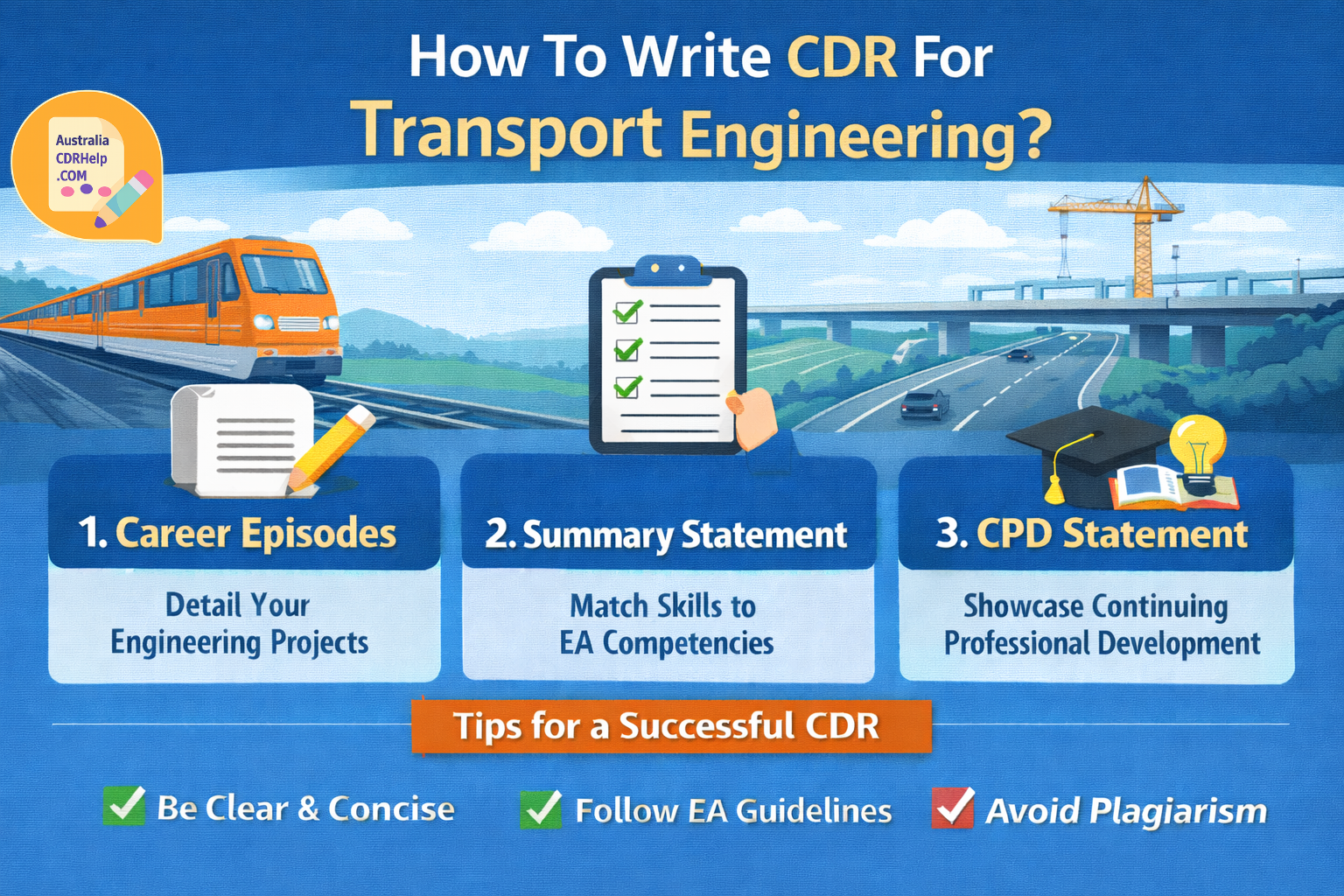
As a CDR is an extensive piece of writing, it comprises three core elements (Three career episodes, a summary statement, and a CPD listing. The report must demonstrate their application of engineering knowledge, focusing on skills related to planning, designing, and developing transport systems.
1. Three Career Episodes:
A Significant description of three engineering projects/activities that the applicants have undertaken during their academics and employment. Each career episode’s narratives must define a different period and specific aspect of engineering application in their nominated OSCA occupation. Each episode must showcase how the applicants applied their particular knowledge, abilities, and experience in their nominated occupation. Each career episode narrative must be 1000 to 2500 words longer and consists of four sections:
- Introduction (approx.150 words): Stating the organisation’s name, date, location, and the job title the applicant holds.
- Background (200-500 words): Describing the nature and objectives of the overall engineering projects, including a chart of the organisation’s structure, highlighting the applicant’s position in relation to the career episode.
- Personal Engineering Activity (600-1500 words): Detailing the actual work performed by the applicants (answering what they did and how they did it). As this is a core section, applicants must illustrate their application of engineering, focusing on their personal contribution (such as the challenges they faced, the strategies they applied, and the solutions they devised).
- Summary (50-150 words): Summarising the project and its overall contribution to the project.
2. A Summary Statement:
A report that cross-references the particular paragraph in the career episode with a competency element required for an engineering occupation in the relevant OSCA. A summary statement must be prepared in an appropriate template for the nominated occupational category (professional engineer, engineering technologist, engineering associate, or engineering manager). Applicants can download the proper summary statement template from the official EA’s website.
3. A CPD Listing:
A continuing professional development (CPD) statement presents details of training, workshops, seminars, courses, technical meetings, technical inspections, self-study, and conferences, including the title, date, duration, venue, and organiser for each, in a table format.
Key Activities And Competencies To Highlight — 243235 Transport Engineer
Applicants must focus on the skills and activities related to the OSCA 243235 responsibilities – (Specialisation Traffic Engineer) as a Transport Engineer.
- Designing, planning, and developing transportation systems to improve infrastructural safety, efficiency, and cost-effectiveness of moving people and freight.
- Designing, planning and analysing transportation systems or components of systems (such as highways, urban transit, ports, rail and airports).
- Analysing and evaluating traffic data to identify and speculate future travel flow patterns, and conducting studies to ensure the feasibility and costs of transportation projects.
- Researching and analysing existing transport systems to identify needs and issues, and planning modifications to improve safety.
- Utilising computer models to simulate transport issues to recognise suitable engineering solutions.
Applicants must be original and genuine in their report writing, making it clear and concise to ensure successful assessment outcomes. Before submitting the CDR report, they must check for accuracy, grammar, coherence, compliance, and clarity to ensure every aspect of the report flows well.
Also Read :- How to Prepare CDR for Australia Migration? Get Expert Help