
A CDR for Instrumentation and Control engineering must express the applicant’s engineering knowledge, potential, and experience in their nominated occupational category for the relevant ANZSCO. Additionally, a competency demonstration report (CDR) must strictly align with the standards outlined in the official migration skills assessment (MSA) booklet from Engineers Australia. Several key factors make a CDR awesome. As it is a lengthy piece of technical writing with rigorous guidelines, it obviously becomes challenging for candidates. However, this guide will help candidates prepare a coherent, compelling CDR for Instrumentation and Control engineering.
AustraliaCDRHelp.com, the industry-leading service provider, offers a one-stop, personalised CDR solution in Australia. As a team of professional writers, we help craft an exceptional report that meets the highest quality standards and aligns with Engineers Australia’s requirements, paving the way for successful immigration. We add creativity with technical expertise to craft a competency assessment report that captivates and convinces, resulting in a positive skills assessment by Engineers Australia. We guarantee our clients’ success by providing genuine, credible support, with a 100% approval rate.
Key Component In Writing A CDR For Instrumentation And Control Engineering
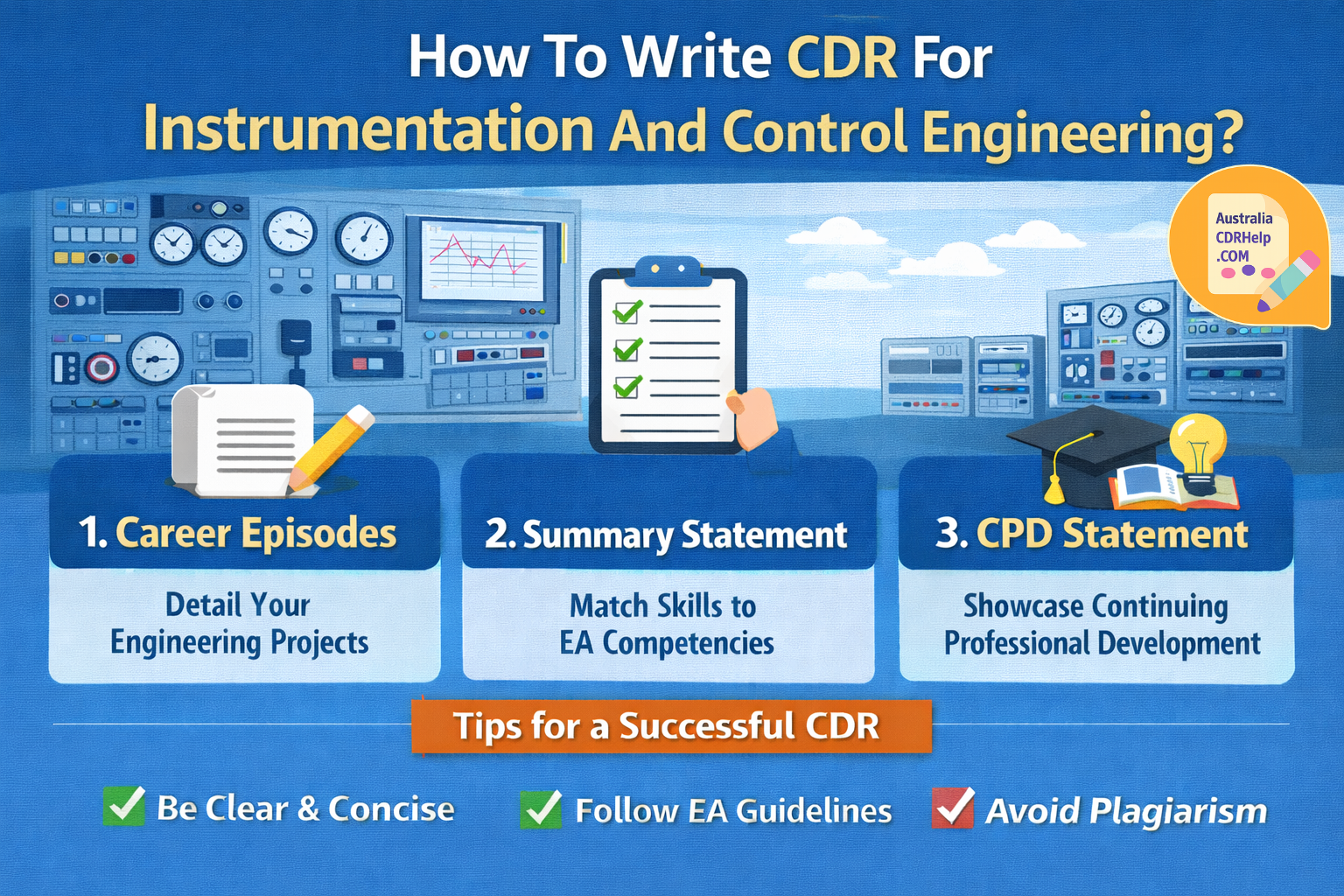
Writing an effective Competency Demonstration Report (CDR) for Instrumentation and Control (I&C) Engineering requires a strategic approach. Here is the step-by-step method:
1. Continuing Professional Development (CPD) Statement:
A record showing how the applicant has taken necessary steps to maintain the currency of their engineering knowledge and skills within their practice area. A CPD listing can include details of postgraduate study, short courses, workshops, seminars, conferences, and self-study. It must be in a table format (title, date, duration, venue, and organiser) and should not exceed one A4 page.
2. Three Career Episodes (CEs):
Detailed narratives of specific projects or work experiences where the applicant applied their engineering knowledge and skills. Each CE should be between 1,000 and 2,500 words and emphasise individual contributions, written in the first person (“I designed,” instead of “we designed”).
3. Summary Statement:
A single, detailed cross-reference matrix that links specific paragraphs in the applicant’s career episode to each of the competency elements required by Engineers Australia.
4. Curriculum Vitae (CV) / Resume:
A comprehensive, up-to-date, and professional CV, in a clear format. It should list an applicant’s education and employment history in reverse-chronological order, including the organisation’s name, location, dates, and job title/position.
5. Supporting Documents:
This includes a valid photo ID, academic degree certificates and official transcripts, employment reference letter, and English language test results (IELTS, TOEFL, or PTE ACADEMIC).
Structuring Career Episodes (CEs)
Career Episodes are the core of the application. Instrumentation and Control engineers CEs should present the applicant’s expertise in process variables, control systems, and automation. It should narrate how applicants applied their knowledge and competence in the nominated occupation. Engineers must structure each CE into four sections, each with numbered paragraphs (e.g., CE 1.1, 1.2, 1.3, and so on).
1. Introduction (approx. 100 words):
Introduces the reader to chronology, geographical location, the name of the organisation, and the applicant’s position title during the episode.
2. Background (200–500 words):
Illustrates the nature and objectives of the overall project, the organisational hierarchy, and the applicant’s specific duties.
3. Personal Engineering Activity (approx. 600-1500 words):
The main body of the career episode details what the applicant personally did and how they applied their engineering knowledge:
- They need to elaborate on how they applied Instrumentation and Control principles (such as designing control loops, selecting sensors and actuators, programming PLCs/DCS).
- They should highlight the technical problems they encountered (such as sensor calibration issues, control system instability, and integration challenges) and the steps they took to address them.
- They need to include creative design work or innovative solutions they developed.
- They should include the implementation and application of professional software or tools (such as MATLAB, AutoCAD, and specific control software).
- They should demonstrate project management skills, including timelines and task management, if applicable.
- They must avoid including excessive calculations or detailed diagrams in the main text; instead, refer to them and give one or two key examples as evidence, if necessary.
4. Summary (approx. 50–150 words):
Conclude the episode by summarising the personal contribution and how the project’s goals were achieved.
Note: The ANZSCO code for instrumentation and control engineering may vary depending on the specialisations and specific job duties, but most frequently the relevant codes are 233513 for (production or plant engineer) and 233999 for ( professional engineer nec), 233311 for (electrical engineer), and 233411 for ( electronics engineer)
Before submitting the CDR on Engineers Australia’s myPortal, candidates must verify the report for spelling and grammatical errors and whether they have included all the necessary documents. If they find everything well, they can lodge their CDR application for skills assessment and wait for the outcome.
Read Other Blog = How To Get Engineers Australia Relevant Skilled Employment Assessment?