
To succeed in the Engineers Australia skills assessment, crafting an excellent CDR is paramount. Many applicants in the Telecommunications engineering discipline feel troubled when writing their competency demonstration report (CDR) and thus struggle to submit a successful CDR application. Several reasons, such as strict norms and procedures, lack of knowledge of migration skills assessment (MSA), and inability to craft a technical report, usually act as barriers to their report preparation. However, this guide will help them eliminate all issues and learn the best approach to crafting a compelling, complete CDR for skills assessment.
To write an impressive CDR for Telecommunications Engineering, applicants must follow the specified MSA guidelines and demonstrate their engineering competencies and problem-solving skills. AustraliaCDRHelp.Com offers a comprehensive guide to writing a CDR report for Telecommunications engineering.
Below are tips for preparing a CDR for Telecommunications Engineering for Engineers Australia (EA)
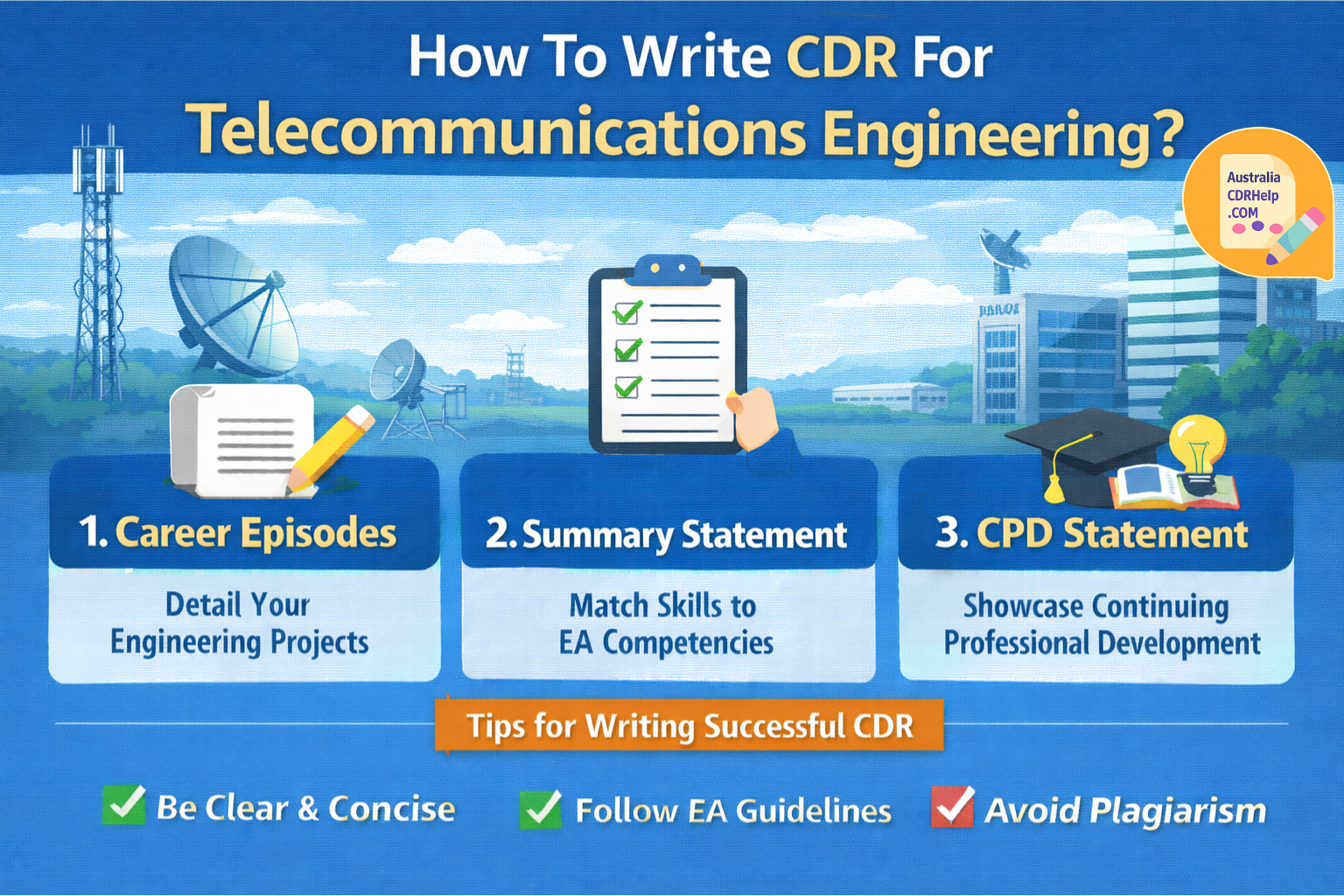
A competency demonstration report is a key to unlocking the skilled migration pathway to Australia. It allows candidates to demonstrate their engineering knowledge, abilities, and professional experience for the nominated ANZSCO occupation. As a CDR is a comprehensive piece of writing, it consists of three key elements (three career episodes, a summary statement, and a CPD report).
I. Structuring Three Career Episodes (CEs)
Career episodes are detailed narratives that demonstrate how candidates applied their engineering knowledge and competence in specific projects or roles. Each career episode must emphasise their personal contributions and actions in the active voice, using first-person pronouns (e.g., “I planned”, “I assessed”, “I resolved”). While formatting their career episodes, applicants must number each episode and its paragraphs (e.g., CE 1.1, 1.2, 1.3, and so on). Each episode’s narrative must follow a structured format:
a. Introduction (Approx. 100 Words):
Candidates must mention the episode’s dates and duration, the organisation’s name and location, and their role.
b. Background (200-500 Words):
They must describe the nature and objectives of the overall project, the organisational structure, and their specific position within it.
c. Personal Engineering Activity (600-1500 Words):
As it is the most crucial part of a career episode, they need to detail the actual work they performed as an engineer (e.g., “What you did and how you did it”).
d. Summary (50-150 Words):
They must summarise their overall contribution to the project and whether the project goals were achieved.
II. Framing A Summary Statement (SS)
It is the conclusive document that ties all three career episodes together, displaying how candidates’ experience meets the competency elements required by Engineers Australia for the nominated ANZSCO occupation (professional engineer, engineering technologist, engineering associate, and engineering manager). This section requires careful analysis and mapping of their experience to the Engineers Australia standards.
III. Listing A Continuing Professional Development (CPD)
It is a list of activities that indicate the steps candidates take to stay up to date with the latest developments in the industry (Telecommunications engineering). They must list a CPD in a table format not exceeding one A4 page. The table can include the title, date, duration, location, and organiser of the training (e.g., short courses, formal postgraduate study, seminars, conferences, workshops, technical meetings, and technical inspections).
Related Link ⇒ CDR for Engineers Australia
Job Duties Of Telecommunications Engineers In Australia –
Telecommunications engineers undertake a wide range of activities, including designing, developing, installing, and maintaining Telecommunications systems and products.
- They plan, design, build, configure, and commission Telecommunications devices, networks, and systems, including satellite, microwave, and digital data systems.
- Determine the appropriate configurations of Telecommunications hardware and software to ensure desired performance.
- Conduct testing and troubleshooting of systems and networks to identify and resolve issues or malfunctions.
- Perform preventive maintenance and upgrades to ensure the efficient operation of communication networks.
- Ensure compliance with relevant laws, regulations, and industry standards in the Telecommunications sector.
- Prepare and analyse specifications, technical drawings, project proposals, and other documentation related to Telecommunications equipment.
- Provide technical advice and information about telecommunication systems to clients, colleagues, and contractors.
To craft an EA-acceptable competency report, applicants must strictly adhere to the specified guidelines. They must check for spelling and grammatical mistakes, as well as ensure clarity, coherence, and compliance, before the final submission of the CDR application.
AustraliaCDRHelp.Com – To Write CDR For Telecommunications Engineers
As a prominent, experienced, and reliable CDR writing services provider, AustraliaCDRHelp.Com helps candidates achieve a successful assessment and a positive outcome letter from the assessor. With a team of highly qualified and veteran writers, we ensure every user receives complete, authentic, and dependable services, enabling them to ace their skills assessment.
With a commitment to quality and client satisfaction, we provide tailored solutions with guaranteed approval.
Related Blog ⇒ How To Write CDR For Telecommunications Field Engineer?