
Relocating to Australia as a Materials Engineer, ANZSCO 233112, is a significant move that involves more than just packing bags. It requires demonstrating that your skills meet local industry standards through a Competency Demonstration Report (CDR) for Engineers Australia (EA) skills assessment.
CDR Report is your primary tool for convincing Engineers Australia that you are ready to contribute to their engineering sector. We understand the pressure to get this right, primarily since it affects your visa outcome. You need to present your career story clearly while staying focused on precise technical requirements.
Simple Steps To Write A CDR For Materials Engineering Skills Assessment
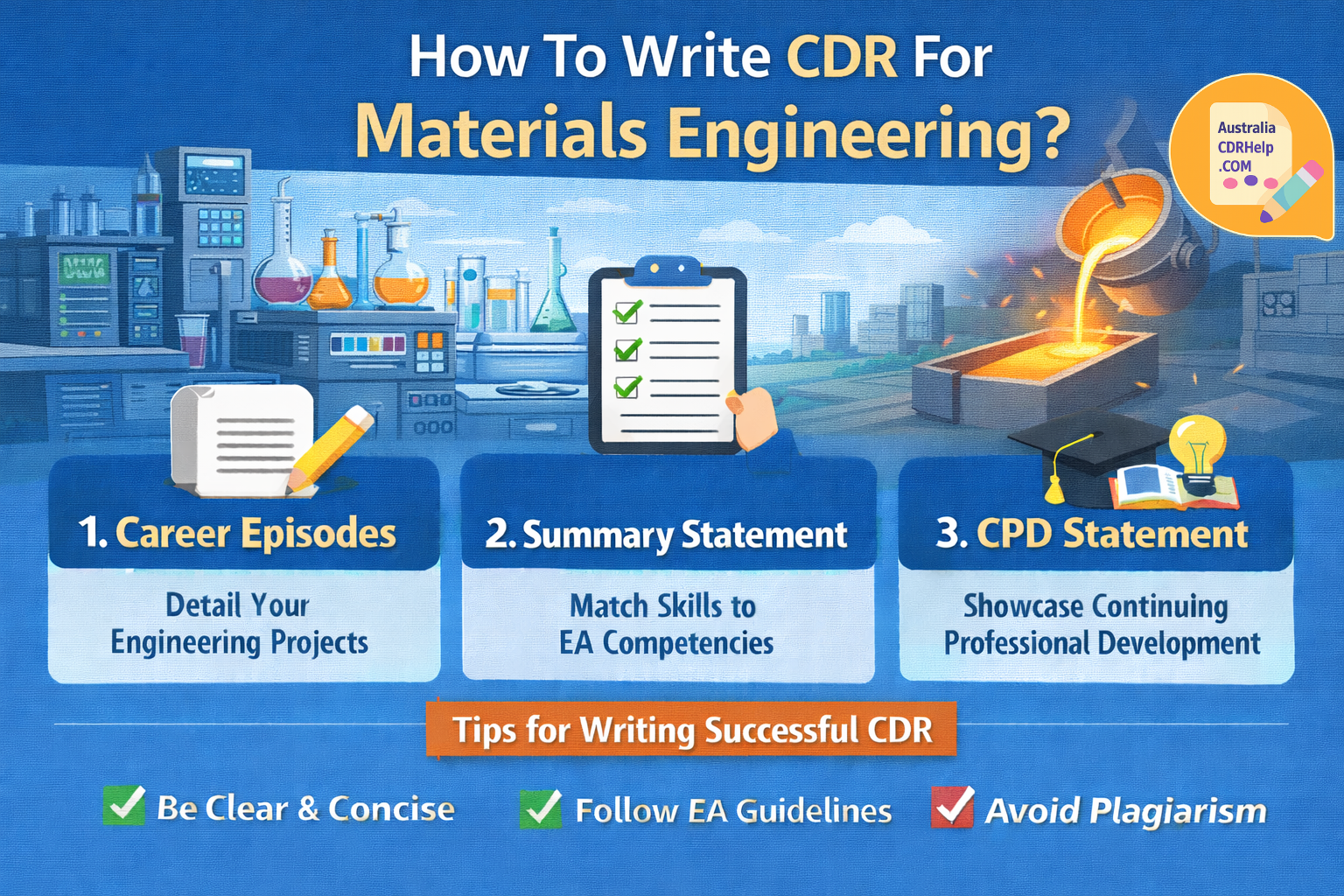
The process of writing a CDR for Materials Engineering should be broken down into manageable parts to avoid feeling overwhelmed. You are building a technical portfolio that covers your education and work history.
A. Step 1: Continuing Professional Development (CPD)
This is a one-page list of everything you have done to stay relevant since you finished your degree. This includes workshops, short courses, and even the technical journals you read regularly.
B. Step 2: Three Career Episodes (CEs)
These are the most important sections. Each episode must describe a specific project or a particular engineering problem you solved. You need to explain the background of the project, your specific role, and the final results. We recommend choosing projects that showcase different aspects of materials engineering to cover all the required competency elements. It’s important for 3 project selections for 3 career episodes. The project may be
- Your academic,
- Internship, mini or
- Work experience-based
It should be a strong project, and it should not be more than 10 years old.
C. Step 3: Summary Statement (SS)
This is where you link your career episodes to the specific competencies that Engineers Australia looks for. You have to provide the exact paragraph numbers where you demonstrated skills like “Ethical Conduct” or “Engineering Analysis.” It serves as a map for the person reading your report.
How Much Money Does A Materials Engineer Earn In Australia?
Financial stability is often the main driver for moving abroad. In Australia, Materials Engineers are well compensated because their expertise is in demand across mining, manufacturing, and construction. Salaries vary depending on which state you settle in and how much experience you bring to the table. For instance, Sydney and Perth often offer higher rates due to the concentration of industrial and mining projects.
| Experience Level | Estimated Annual Salary (AUD) |
| Graduate Materials Engineer | $75,000 – $92,000 |
| Mid-Level (3-7 Years) | $110,000 – $135,000 |
| Senior Materials Engineer | $150,000 – $185,000+ |
The average pay sits around $120,000 per year. While regional areas might offer slightly lower base pay, the lower cost of living or remote work allowances often make up the difference. It is also common for specialists in metallurgy or polymers to negotiate higher packages if they have niche skills that are in short supply.
Related Link ⇒ CDR for Engineers Australia
What Are The Roles And Responsibilities Of Materials Engineers In Australia?
Your daily work involves a lot of trial and error with raw substances to create better products. Engineers Australia (EA) wants to see that you have handled these tasks personally. They are looking for your ability to apply scientific principles to solve industrial problems.
Some of the Core Tasks you should highlight in your CDR Report include:
- Testing the properties of metals, ceramics, and polymers to see how they behave under heat or pressure.
- Investigating why a specific material failed in the field and proposing a better alternative.
- Designing manufacturing processes that turn raw materials into finished engineering components.
- Collaborating with other engineering teams to select the right materials for bridge building or aircraft parts.
- Monitoring quality control standards to make sure every batch of material meets safety regulations.
- Developing new composites or sustainable materials to reduce the environmental impact of production.
Technical Skills You Should Highlight –
Beyond the general responsibilities, you need to show your grasp of modern engineering tools. If you have used specific software for material simulation or characterisation, mention it. Focus on your experience with scanning electron microscopy (SEM) or X-ray diffraction (XRD) if applicable.
Showing that you can manage the lifecycle of a material from its raw state to recycling is very popular in Australia right now. Sustainability is no longer a “nice to have” skill; it is often a requirement in modern Australian projects.
Common Errors That Lead To CDR Rejection For Materials Engineers
Many talented engineers fail the assessment not because they lack skill, but because they miswrite the report. One of the biggest mistakes is writing about what your “team” did instead of what “you” did. Use “I” constantly. Another issue is copying content from online samples.
Engineers Australia uses very advanced software to detect any text that isn’t original. Even if you only copy a small part for “inspiration,” it can lead to a long-term ban. Also, avoid being too theoretical; the assessors want to see practical engineering applications, not a repeat of your university textbooks.
How AustraliaCDRHelp.Com Provides CDR Writing Services For Materials Engineering?
AustraliaCDRHelp.Com knows that translating years of technical work into a report that meets the requirements of migration authorities is a tall order. Our team focuses on aligning your specific project experience with the ANZSCO 233112 requirements.
We provide high-quality support to ensure your CDR report is original and follows all Australian standards. If you are worried about the technical writing or the strict assessment criteria, we offer the professional guidance you need to move forward with your migration plans.
Related Blog ⇒ How to Make CDR for Engineers Australia?