
Preparing a Competency Demonstration Report (CDR) for Engineers Australia (EA) is a major step for those looking to migrate to live or work in Australia. As a structural engineer: ANZSCO 233214, they need to show that they can handle the weight of Australian standards, both literally and figuratively. It is not just about listing your jobs; it is about proving you have the technical brains to design safe buildings, bridges, and tunnels under local conditions.
What Is CDR For Structural Engineering?
A CDR for Structural Engineering presents the competence for ANZSCO 233214 through structured documents that reflect real projects you handled. You show how you analyse loads, design members, and manage safety for structures such as buildings, bridges, and other load-bearing systems.
*Key Points For Structural Engineering CDR:
- Focus on structural design, analysis, and site supervision, not generic civil work.
- Highlight the use of tools such as ETABS and STAAD.Pro, SAP2000, SAFE, Revit, or similar software in real projects.
- Use Australian English and provide precise, factual descriptions of your role and outcomes.
How Much Does A Structural Engineer Make In Australia?
For your context section, you can refer to current salary trends and relate them to your level of responsibility.
- The Average Structural Engineer’s Salary in Australia is around AUD 95,000 to AUD 120,000 per year, depending on experience and sector.
- Entry-Level Structural Engineers often start near AUD 80,000 to AUD 90,000 annually, while experienced or senior engineers may exceed AUD 130,000.
- Graduate Structural Engineers usually see starting packages in the AUD 67,000-81,000 range.
What Structural Engineers Do In Australia?
Structural Engineers have various roles, and the tasks should match recognised structural engineering responsibilities under ANZSCO 233214.
*Key Roles And Responsibilities –
- Design and analyse structural elements for buildings, bridges, tunnels, and other infrastructure, considering gravity, wind, seismic, and live loads.
- Select construction materials such as reinforced concrete, structural steel, timber, or composites, and assess their performance against Australian standards such as AS3600 and AS4100.
- Prepare and review drawings, specifications, and calculation reports using CAD and structural analysis software.
- Supervise construction, inspect on-site structural work, and verify compliance with approved design, codes, and safety requirements.
- Investigate structural defects, assess the capacity of existing structures, and recommend strengthening or remediation options.
- Coordinate with architects, geotechnical engineers, services engineers, and contractors to resolve clashes and maintain structural integrity.
You can weave these responsibilities into your Career Episodes so they clearly reflect Australian practice for structural engineers.
Related Link ⇒ CDR for Engineers Australia
Core Components Of Structural Engineering CDR –
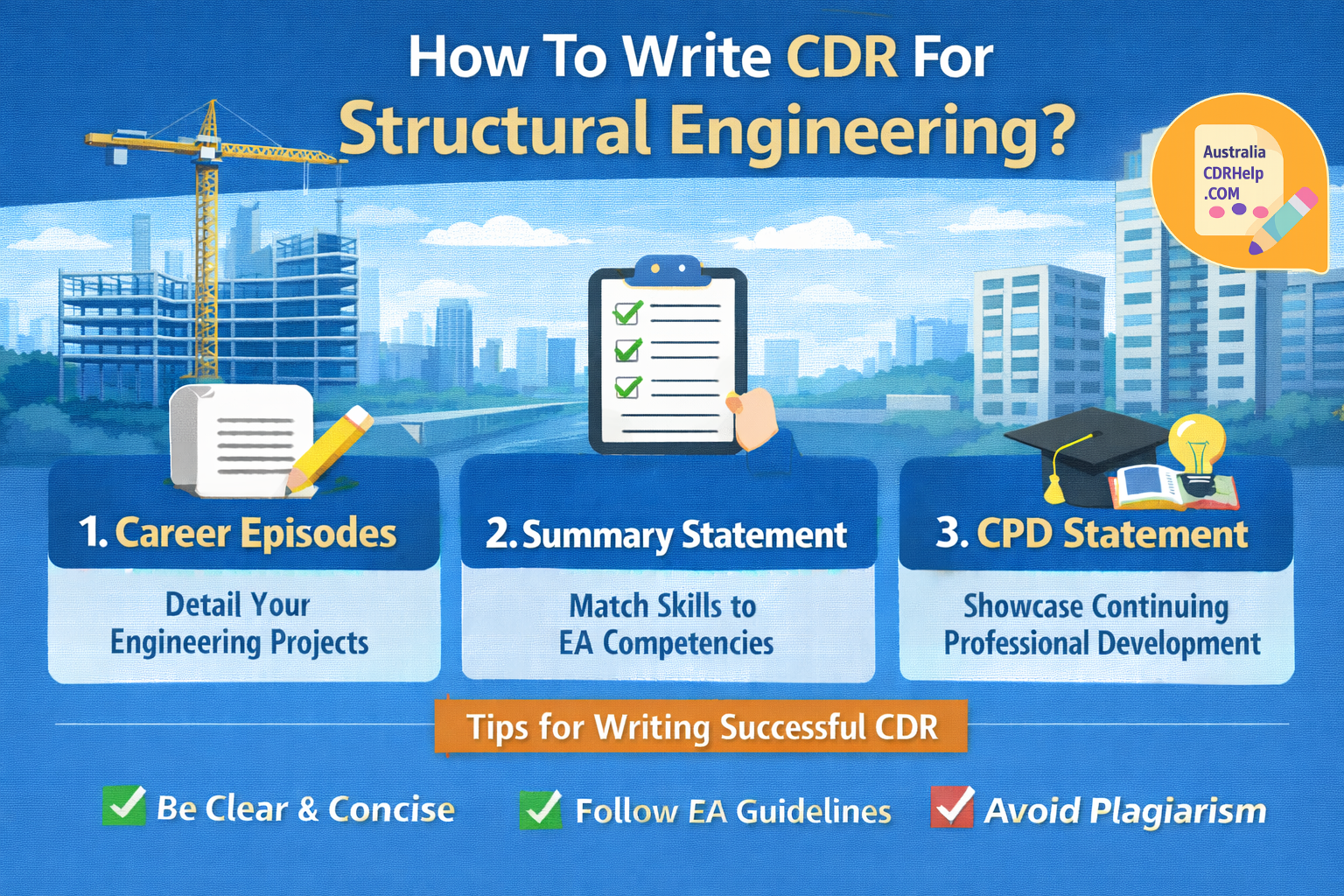
Your CDR usually includes a CV, Continuing Professional Development, three Career Episodes, and a Summary Statement that aligns with Engineers Australia competencies.
I. Curriculum Vitae (CV)
Your CV presents your structural engineering history in a concise format that supports the episodes.
- Use reverse-chronological order, with clear dates, job titles, and employer details.
- List structural responsibilities, such as design of beams, slabs, frames, foundations, and site inspections, under each role.
- Mention the software you use and any exposure to Australian or international codes.
II. Continuing Professional Development (CPD)
CPD shows how you stay current in structural engineering practice and with standards.
Include Items in List Form, Such As:
- Short Courses on structural design to AS codes or seismic design.
- Workshops on finite element analysis, steel connection design, or foundation engineering.
- Seminars on concrete durability, bridge inspection, or advanced materials.
- Technical Webinars and internal training on safety, quality, or BIM workflows.
III. Three Career Episodes For Structural Engineering CDR
Career Episodes carry most of the technical weight of your CDR, so structure them carefully around structural projects.
*Structure Of Each Career Episode
Each episode covers a single project or role where you had designated structural responsibilities.
Recommended Flow:
- Introduction: project title, employer, location, role, and time frame.
- Background: project scope, design brief, and your place in the team.
- Personal Engineering Activity: detailed description of what you designed, analysed, checked, and managed.
- Summary: closing comments on project outcomes and what you learned as a structural engineer.
A) What To Highlight In Structural Episodes?
Your writing needs to show your individual contribution to structural work, not just team activity.
Emphasise Points Such As:
- Load Assessment and structural system selection for buildings, industrial facilities, or bridges.
- Sizing of Beams, slabs, columns, shear walls, trusses, or foundations, with mention of key checks you performed.
- Use of Software Models to verify deflections, internal forces, and stability under different load combinations.
- Coordination with Architects to adjust framing layouts for functionality and aesthetics while keeping structural efficiency.
- Handling Site Issues such as reinforcement congestion, steel fabrication tolerances settlement, and how you resolved them.
- Application of Relevant Codes and standards, including justification for design choices and safety factors.
B) Example Table: Content To Cover In Episodes
You can use a table during planning to keep each episode focused on structural tasks.
| Episode Part | Structural Engineering Focus Example |
| Introduction | Structural design engineer for a 20-storey reinforced concrete building |
| Background | Project objective, design life, performance criteria, and applicable Australian codes |
| Personal Activity | Load modelling, member design, connection detailing, and coordination with site teams |
| Calculations and Tools | Use of ETABS and manual checks to verify strength, serviceability, and stability |
| Site Involvement | Inspections, non-conformance reports, and approval of structural changes during construction |
| Summary | Performance outcomes, design improvements, and skills gained as a structural engineer |
IV. Summary Statement In CDR (Competency Demonstration Report)
Your Summary Statement and supporting papers tie the CDR together and give Engineers Australia confidence in your structural experience.
a) Summary Statement
The Summary Statement maps elements of your episodes to EA competency units and indicators.
To Keep it Relevant to Structural Engineering:
- Cross-reference where you applied structural theory, material mechanics, and structural analysis.
- Point to Paragraphs that show risk management, safety in design, and compliance with standards.
- Highlight leadership, stakeholder communication, and ethical decisions taken during structural projects.
b) Supporting Documents
Supporting documents help validate your structural work and professional history.
Key Items Include:
- Personal Identification and academic certificates in structural or civil engineering.
- Employment Letters that specify your position as a structural engineer and list core duties.
- Project Reports, calculation sheets, and structural drawings that align with your Career Episodes.
- English Language Test Results that meet EA requirements for migration skills assessment.
A final declaration that your CDR is your own work and not copied from online samples is also an important part of the package.
AustraliaCDRHelp.Com – To Write A Winning CDR For Structural Engineering
Crafting a perfect CDR requires both technical engineering knowledge and strong English report-writing skills. At AustraliaCDRHelp.Com, we help structural engineers bridge that gap.
We ensure your CDR report is 100% plagiarism-free, aligned with the latest Migration Skills Assessment (MSA) booklet, and focused on the technical keywords EA assessors seek.
AustraliaCDRHelp.Com, helps you identify the best projects from your career to highlight. We align your technical jargon with Australian industry standards. We perform rigorous plagiarism checks to ensure a smooth approval process.
Related Blog ⇒How to Make CDR for Engineers Australia?