
If you are an engineering professional seeking to migrate to Australia, the Competency Demonstration Report (CDR) is the most critical document in your application. It serves as the primary gateway for those who do not hold qualifications from an Australian university or an institution accredited under the Washington, Sydney, or Dublin Accords.
Essentially, the CDR is your opportunity to prove to Engineers Australia (EA) that your skills, knowledge, and professional experience align with Australian standards.
Defining the Competency Demonstration Report (CDR)
A CDR for Engineers Australia is a technical dossier that showcases your engineering competencies. It is not a simple resume or a collection of certificates; rather, it is a detailed narrative of your career and academic background. The document allows Engineers Australia to assess whether you are eligible for a specific occupational category, such as
- Professional Engineer,
- Engineering Technologist,
- Engineering Associate, or
- Engineering Manager.
To navigate this process successfully, you must understand that the assessment is based on how you have applied your engineering knowledge in real-world scenarios. It is less about the prestige of your university and more about your ability to demonstrate specific competencies required in the Australian workforce.
The Core Purpose of the CDR Skills Assessment
The primary reason you are required to submit a CDR is to facilitate the Migration Skills Assessment (MSA). The Australian Department of Home Affairs relies on Engineers Australia to vet the technical qualifications of overseas applicants. Without a positive outcome from this assessment, you cannot proceed with a skilled migration visa application. Beyond migration, a successful CDR provides professional recognition, ensuring your skills are validated against the Australian Qualifications Framework (AQF).
Critical Components of a Successful CDR for EA
Preparing a CDR is a rigorous process that requires you to adhere to the guidelines set out in the Migration Skills Assessment (MSA) Booklet. The document is divided into three distinct sections, each serving a specific purpose in proving your technical aptitude.
The following table provides a quick overview of what you must include in your submission:
| Component | Purpose | Key Requirement |
| CPD (Continuing Professional Development) | Shows you are up to date with the latest engineering trends. | Must be in a list format, not exceeding one A4 page. |
| Three Career Episodes | Narrative accounts of specific engineering projects. | Written in first person; focuses on your individual role. |
| Summary Statement | Cross-references the episodes to EA’s competency units. | Requires precision and careful paragraph mapping. |
Continuing Professional Development (CPD)
Your CPD is a record of everything you have done to stay relevant in your field after completing your undergraduate degree. This includes formal post-graduate study, conferences you have attended, workshops, or even private study of technical manuals and journals. It demonstrates to the assessors that you are committed to professional growth and are aware of the evolving nature of global engineering standards.
The Three Career Episodes Report (CERs)
These are the heart of your CDR. You must choose three distinct projects or engineering activity periods that showcase different aspects of your skills. Each episode should be roughly 1,000 to 2,500 words and must be written entirely in the first person. This is crucial because the assessor is not interested in what your team did; they want to see what you specifically designed, calculated, or managed.
You should structure these episodes to include:
- An introduction (dates, location, and your role).
- Background information on the project.
- Personal Engineering Activity (the technical details of your work).
- A summary of the project’s outcomes.
CDR Summary Statement
Once you have finished your career episodes, you must complete the Summary Statement. This is perhaps the most difficult part of the CDR report. You have to map specific paragraphs from your career episodes to the competency elements required by Engineers Australia. If you fail to demonstrate even one required competency, your entire application could be rejected. It serves as a guide for the assessor to find evidence of your skills within your narratives.
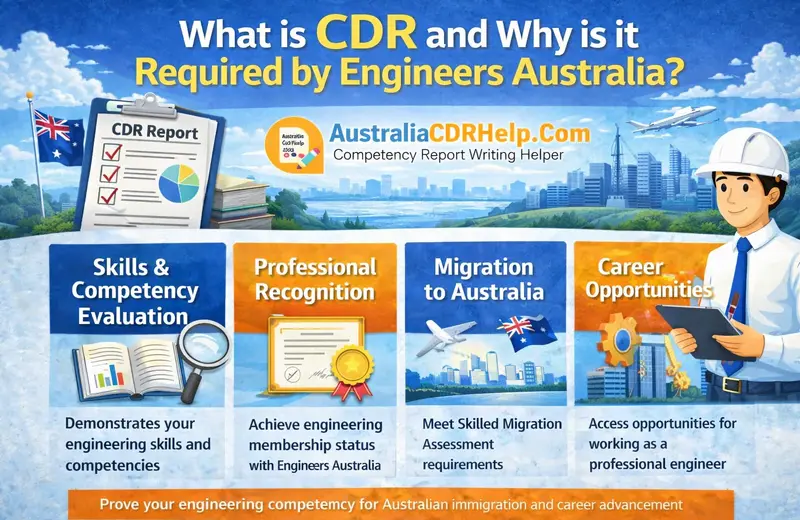
Why You Need a CDR for Australian Migration?
The Australian engineering landscape is highly regulated to ensure public safety and the integrity of infrastructure. Therefore, the CDR acts as a quality control mechanism. It ensures that every engineer entering the country, regardless of where they were trained, possesses the fundamental skills necessary to contribute to the local economy without extensive retraining.
Related Link ⇒ CDR for Australian PR
Alignment with ANZSCO Standards
When you apply, you must nominate an occupation from the ANZSCO (Australia and New Zealand Standard Classification of Occupations) list. Each code has a specific set of duties and educational requirements. Your CDR must prove that you can perform the tasks associated with your chosen ANZSCO code. For instance, if you are applying as a Civil Engineer, your career episodes must focus on structural analysis, materials, or site management rather than general project management.
Overcoming Educational Gaps
If your degree is from a country not covered by international accords, the CDR is the only way to bridge that gap. It allows you to demonstrate that while your formal education might be different, your practical experience has brought you up to the level of an Australian graduate. It’s a performance-based assessment rather than a purely certificate-based one.
Technical Requirements and Compliance
Accuracy is non-negotiable when drafting your CDR. Engineers Australia uses advanced plagiarism detection software to ensure that every report is unique. Using templates found online or copying someone else’s project details will result in an immediate ban from the assessment process.
Furthermore, you must pay close attention to:
- Language Proficiency: You usually need to provide PTE or IELTS results to prove you can communicate effectively in a professional Australian environment.
- Evidence of Employment: Any claim you make in your career episodes regarding work experience must be backed up by official reference letters or payslips.
- Formatting: Every paragraph in your career episodes must be numbered (e.g., 1.1, 1.2, 1.3) so they can be easily referenced in the Summary Statement.
Finalising Your Submission for Approval
The path to a successful skills assessment requires a balance of technical writing and self-promotion. You are not just writing a report; you are building a case for your professional life in Australia. Ensure that your English is clear, your technical details are accurate, and your Summary Statement is meticulously mapped to your career episodes.
By focusing on the specific engineering problems you solved and the technical decisions you made, you provide the assessor with exactly what they need to grant a positive outcome. Taking the time to refine these details now will significantly reduce the risk of receiving a request for additional information or a rejection letter.
AustraliaCDRHelp.Com offers clear guidance on the CDR, outlining its role as a key technical portfolio. We explain how the report demonstrates engineering competencies and ensures international candidates meet Engineers Australia’s standards.
Related Blog ⇒ How to Write Competency Demonstration Report (CDR)?