
The Competency Demonstration Report (CDR) is the most critical document for Biomedical Engineers seeking a migration skills assessment from Engineers Australia. If your qualification is from a country not signatory to the Washington Accord or if your degree is not explicitly accredited, the CDR is your primary pathway to demonstrate that your professional competencies align with Australian standards.
This report is not a mere summary of your employment; it is a technical portfolio that requires a high degree of precision and adherence to the Migration Skills Assessment (MSA) booklet.
To succeed, you must present a narrative that balances your biological science knowledge with core engineering principles. Engineers Australia (EA) assesses you under the ANZSCO code 233913, and your CDR report must reflect the specific responsibilities associated with this professional category.
How to Align Your CDR with ANZSCO 233913 Biomedical Engineer?
Before you begin drafting, you must ensure your project selection reflects the duties of a Biomedical Engineer. In the Australian context, this role involves more than just maintenance; it focuses on the design, development, and management of medical equipment and biological systems.
The following table outlines the core competencies and technical areas you should emphasise to meet the EA criteria:
| Competency Area | Technical Focus for Biomedical Engineers |
| Design & Development | Developing artificial organs, prosthetics, or diagnostic imaging software. |
| Equipment Management | Establishing maintenance protocols for ventilators, MRI machines, or infusion pumps. |
| Regulatory Compliance | Adhering to Therapeutic Goods Administration (TGA) standards or ISO 13485. |
| Signal Processing | Using MATLAB or LabVIEW for physiological signal analysis (ECG, EEG). |
| Risk Management | Conducting electrical safety checks and clinical risk assessments. |
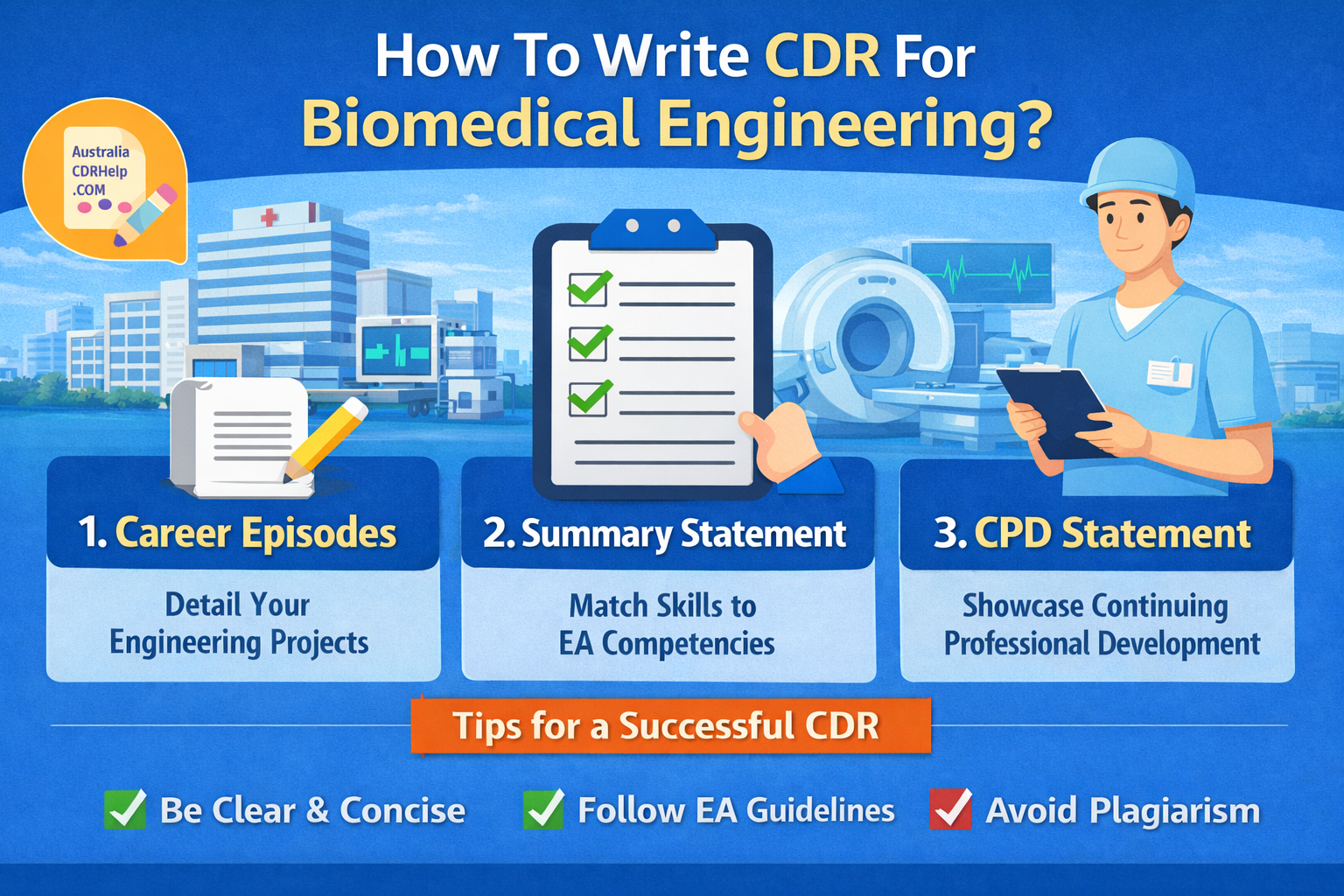
Structuring the Three Career Episodes for ANZSCO 233913 Biomedical Engineer
Your Career Episodes (CE) are the heart of the CDR. Each episode should focus on a distinct engineering project or a specific period of professional activity. For a biomedical engineer, these can range from a university thesis project to a complex hospital equipment implementation.
Each CE must be written in the first person to ensure the assessor can clearly identify your personal contribution to the project. You should follow a logical narrative structure for each episode:
- Introduction: Approximately 100 words identifying the project, dates, location, and your specific role.
- Background: 200–500 words detailing the project objectives, the organisational structure, and the nature of the specific engineering problem you were tasked to solve.
- Personal Engineering Activity: 500–1000 words focusing on the “how.” This is where you describe your technical calculations, the software you used, the standards you followed, and the specific challenges you overcame.
- Summary: 50–100 words reflecting on the project outcomes and how you met the initial goals.
When writing the “Personal Engineering Activity,” avoid being too descriptive about the team’s achievements. If you designed a non-invasive blood pressure monitoring system, describe the specific filters you applied to the signal and the mathematical models you used to validate the accuracy. If you were involved in hospital procurement, detail the technical specifications you developed to ensure the equipment met clinical requirements.
CDR Summary Statement for ANZSCO 233913 Biomedical Engineer
Once your Career Episodes are complete, you must map your experiences to the Summary Statement. This document is a cross-reference table that links the competency elements defined by Engineers Australia to the specific paragraphs in your episodes. It is divided into three sections: Knowledge and Skill Base, Engineering Application Ability, and Professional and Personal Attributes.
The Summary Statement is often where applicants fail, as they often provide generic descriptions. You must be specific. For instance, if you are addressing “Element 2.1: Application of established engineering methods,” you should refer to a paragraph where you used a specific biomechanical analysis or a finite element method (FEM) to test a prosthetic limb. Do not simply state that you are a competent engineer; provide the paragraph number where the proof exists.
Developing CPD for ANZSCO 233913 Biomedical Engineer
The CPD is a one-page list that shows how you have kept your knowledge current after graduation. For biomedical engineering, the technology evolves rapidly, and your CPD should reflect your engagement with modern medical advancements.
Your CPD list should include:
- Formal post-graduate study or short courses related to medical device regulations.
- Seminars or workshops on new diagnostic technologies or hospital information systems.
- Private study, including technical journals or books on biomechanics and tissue engineering.
- Participation in professional engineering societies or volunteer work within the healthcare sector.
This section does not require a narrative. A simple table or list including the title, date, duration, and venue of the activity is sufficient. It serves as evidence that you are an active member of the engineering community who prioritises lifelong learning.
Related Link ⇒ CDR for Engineers Australia
Maintaining Technical Precision and Standards
A successful CDR for ANZSCO 233913 Biomedical Engineer must demonstrate that you understand the intersection of engineering and patient safety. You should mention specific Australian or International Standards for the management of medical devices or ISO 14971 for risk management. Using these references shows the assessor that you possess the professional maturity to work within the Australian regulatory framework.
Finally, ensure your tone is formal and that you avoid industry jargon that isn’t backed by a technical explanation. While you are writing about complex biological systems, your primary goal is to prove you are an engineer first. Focus on the mechanics, the data, and the systematic approach you took to solve every problem encountered during your projects.
For expert guidance in aligning your technical narrative with these strict requirements, Australia CDR Help provides comprehensive support to ensure your report meets all Engineers Australia standards.
Related Blog ⇒ How Much Do Biomedical Engineers Earn in Australia?