
A Competency Demonstration Report (CDR) for Civil Engineer ANZSCO 233211 is the primary document required by Engineers Australia (EA) to assess your skills if your qualifications are from a country not signatory to the Washington Accord. The EA CDR report is a technical portfolio that demonstrates your knowledge and practical experience in meeting Australian professional standards. It is not a career history; it is evidence of your engineering competency.
The assessment hinges on your ability to articulate how you applied civil engineering principles to solve specific problems. You must follow the Migration Skills Assessment (MSA) booklet guidelines strictly, ensuring every claim is backed by technical detail and personal contribution.
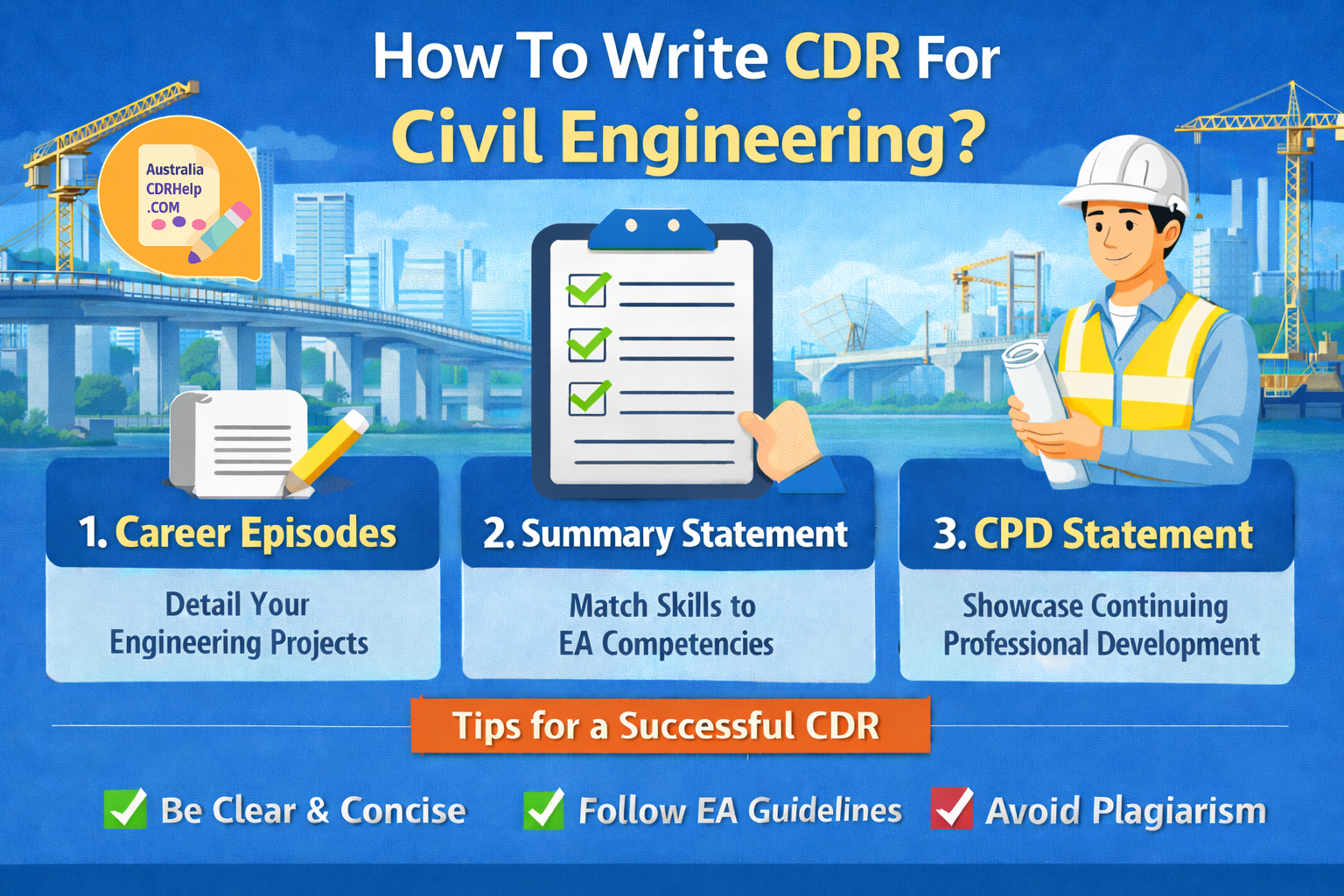
To draft a successful CDR, you must understand the three core components:
- Continuing Professional Development (CPD) list,
- Three Career Episodes, and
- Summary Statement.
Each section must be written in Australian English and focus entirely on your individual role.
Before you start writing, organize your documentation, including project reports, calculations, and design drawings, as these will form the basis of your narrative.
Step-by-Step Guide to Writing Your Career Episodes for ANZSCO 233211 Civil Engineering
The career episodes are the most time-consuming part of the CDR report. They must be written in an essay format, focusing on your personal performance rather than the team’s achievements. Avoid technical jargon that doesn’t serve a purpose; instead, focus on clear descriptions of the engineering problems you faced.
You need to write three distinct career episodes. Each episode should focus on a specific project or a defined period of your professional activity. The aim is to demonstrate different aspects of the civil engineering competency elements. For example, one episode might focus on structural design, while another focuses on site management or traffic engineering.
Step 1: Define the Project Scope
Begin each episode with a clear introduction. State the project title, the dates you were involved, the location, and the name of the organisation. Follow this with a brief background to provide context for your role. You should explain the project team hierarchy to show where you stood and who you reported to.
Step 2: Detailing Your Personal Engineering Activity
This is the most critical section, usually making up the bulk of the 1,000 to 2,500 words required for each episode. You must describe the specific tasks you performed. For a Civil Engineer, this should include:
- How did you conduct site investigations or soil tests?
- The specific structural calculations you performed for loads, stresses, or hydraulic flows.
- The design software you utilised, such as AutoCAD, Civil 3D, or SAP2000.
- The technical standards you followed.
Step 3: Addressing Challenges and Solutions
Engineers Australia wants to see how you handle complexity. Describe a specific technical problem that arose during the project. Explain the options you considered, the engineering principles you applied to evaluate those options, and the final solution you implemented. Be specific if you modified a foundation design due to unexpected soil conditions; explain the math and the reasoning behind the change.
Related Link ⇒ CDR for Engineers Australia
Writing the Summary Statement
The Summary Statement is the final document you prepare, but it is the first one the assessor reads. It links the competencies required by EA to the specific paragraphs in your Career Episodes.
You must be precise in your cross-referencing. For example, if a competency element asks for “Application of systematic engineering synthesis and design processes,” you must point to the exact paragraph in a Career Episode where you described a design task.
| Competency Element | Example of Evidence for Civil Engineers |
| PE1.1 Knowledge of Science and Engineering | Describing the use of fluid mechanics in a drainage project. |
| PE2.1 Application of Established Methods | Documenting the use of AS 1170 for wind load calculations. |
| PE2.3 Design Processes | Detail how you moved from a conceptual design to a final detailed blueprint. |
| PE3.2 Effective Communication | Describing the technical reports or site instructions you authored. |
CPD (Continuing Professional Development)
Your CPD is a one-page list that shows you have stayed current with developments in civil engineering. It should include any formal post-graduate study, conferences you attended, or technical workshops. For a civil engineer, this might include training in structural analysis software and Revit, as well as workshops on local building codes and sustainability standards.
Mentioning Safety and Environmental Management
Civil engineering projects have significant environmental and safety footprints. You must explain how you incorporated Work Health and Safety (WHS) safety protocols into your designs or site management. Detail any environmental impact assessments you contributed to or how you managed waste and resource efficiency on-site.
Technical Competencies for Civil Engineers (ANZSCO 233211)
When drafting your CDR for Civil Engineers, you must align your experience with the specific duties listed under the ANZSCO 233211 code. This involves more than just “supervising”; it requires proof of engineering design and analysis.
Focus on these key areas to ensure your report meets the threshold for a professional engineer:
I. Structural Analysis and Design
Provide evidence of your ability to design structures that withstand various loads. This includes calculating bending moments, shear forces, and axial loads. If you worked on a high-rise, bridge, or industrial warehouse, describe how you ensured the structural integrity of the project.
II. Hydraulic and Water Resource Management
If your project involved drainage, irrigation, or water supply, explain the hydraulic modelling you performed. Mention the flow rates, pipe sizing, and how you addressed potential flooding or pressure issues.
III. Construction and Project Management
While the CDR is a technical document, a Civil Engineer must also show competency in management. This includes scheduling, cost estimation, and procurement. Mention how you managed subcontractors or ensured that materials met the required specifications.
Maintaining Professional Integrity and Accuracy
Plagiarism is the most common reason for CDR rejection. Engineers Australia uses sophisticated software to check your work against online samples and previous submissions. Even if you use a sample as a template, ensure every sentence is an original reflection of your own work.
Use Australian English spelling and formal terminology. Instead of saying “I helped with the project,” say “I coordinated the structural design phase.” Avoid “filler” sentences that don’t add technical value. Every paragraph should serve as proof that you can operate as a professional engineer in the Australian industry.
Related Blog ⇒ How Much Money Does a Civil Engineer Make in Australia?