
Preparing a Competency Demonstration Report (CDR) for Engineers Australia is a high-stakes task. If you are a chemical engineer, your report must prove that your skills align with the Australian standards for the occupation (ANZSCO 233111). This document is not a simple resume; it is a technical narrative that demonstrates your ability to apply engineering knowledge to complex problems.
The primary goal of your CDR is to show how you have applied chemical engineering principles in real-world scenarios. This includes your understanding of process design, thermodynamics, mass and energy balances, and plant safety. You must follow the specific guidelines provided by Engineers Australia in the Migration Skills Assessment (MSA) booklet.
The Essential Components of a Chemical Engineering (ANZSCO 233111) CDR
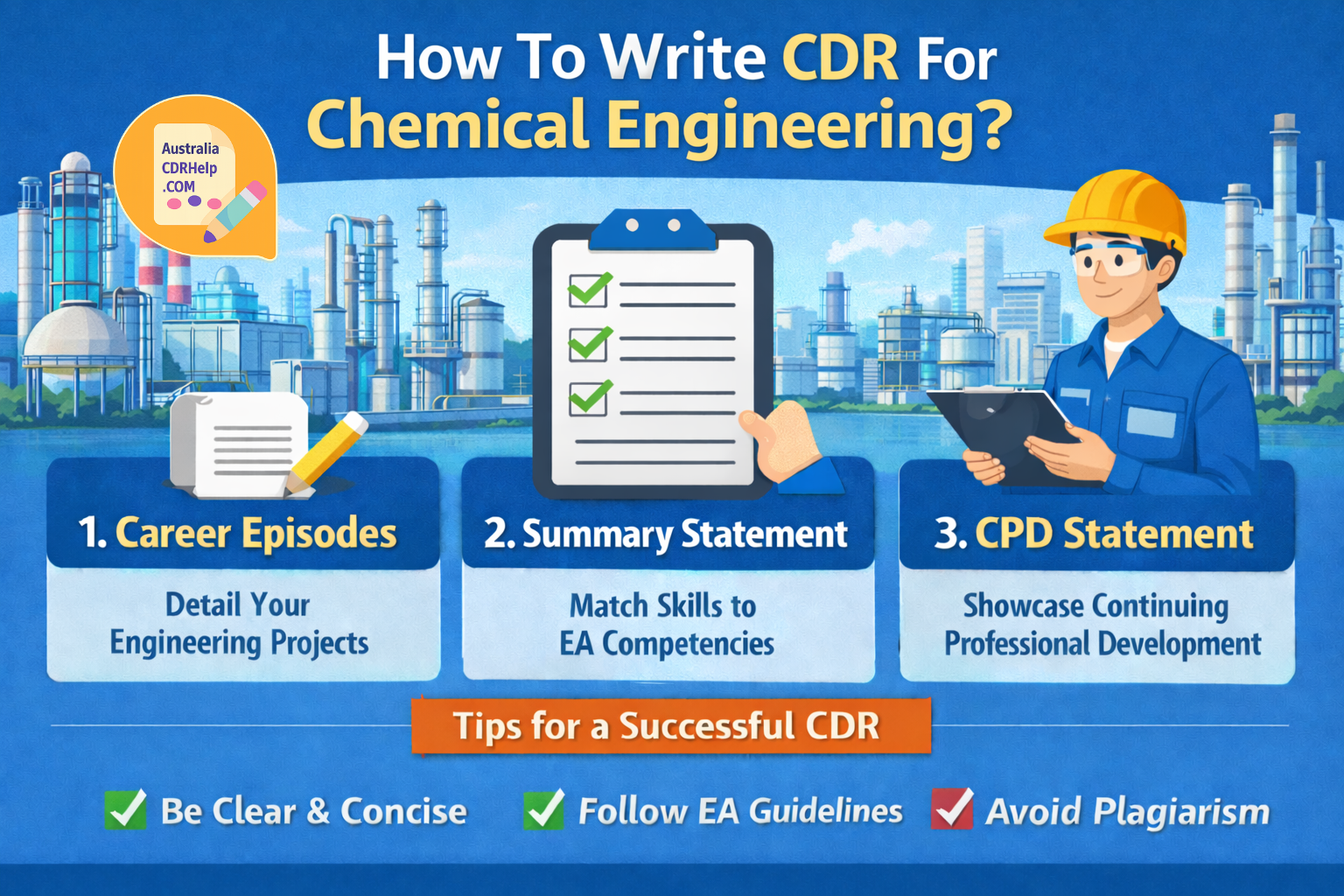
Before you begin writing a CDR for Chemical Engineering, you need to understand the four main elements required in your submission. Each piece serves a distinct purpose in proving your competency.
To ensure your report is comprehensive, you must gather all technical data from your past projects. Missing technical evidence often leads to a request for more information or an outright rejection.
I. Three Career Episodes
These are the core of your CDR. Each episode focuses on a specific period or a distinct aspect of your engineering activity. You should select projects where you had a significant personal contribution. For a chemical engineer, this could be a plant commissioning project, a process optimisation task, or a design phase for a new reactor.
II. The Summary Statement
This is a single-page document that cross-references your career episodes with the specific competency elements required by Engineers Australia. It is the first thing the assessor looks at to see if you have covered all the necessary bases.
III. Continuous Professional Development (CPD)
The CPD is a list that shows you are keeping up to date with advancements in the chemical engineering field. It should be presented in a simple table or list format. Include any post-graduate workshops, seminars, or technical conferences you have attended. You should also mention any private study, such as reading technical journals or learning new process simulation software.
Step-by-Step Guide to Drafting Career Episodes in CDR for ANZSCO 233111 Chemical Engineering
Your career episodes must be written in an essay format and should never be broken down into simple bullet points. They need to tell a story of a specific engineering problem and how you solved it.
Step 1: Select Your Projects Carefully
Choose three projects that show a variety of skills. For example, use one episode for a design project involving Aspen HYSYS or PRO/II, another for on-site plant operations or troubleshooting, and a third for a safety-focused project, such as a HAZOP (Hazard and Operability) study. Diversity in your project selection makes it easier to tick off different competency elements in the summary statement.
Step 2: Use the Correct Writing Voice
Write in the first person. Engineers Australia wants to know what you did, not what the team did. Instead of saying “We installed a distillation column,” write “I calculated the required number of theoretical stages and specified the reflux ratio for the distillation column.” Use active verbs like designed, calculated, investigated, managed, and optimised.
Step 3: Structure Each Episode Properly
Each episode should follow a specific flow:
- Introduction: Approximately 100 words. Mention the dates, location, and the name of the organisation.
- Background: About 200 to 500 words. Describe the overall project and your specific role.
- Personal Engineering Activity: This is the meat of the report (500 to 1000 words). Detail the technical tasks you performed. Mention the specific chemical engineering formulas or software you used.
- Summary: Roughly 50-100 words. State whether the project goals were met and mention any personal awards or recognition.
Step 4: Focus on Technical Calculations and Design
You cannot be vague. If you mention heat exchangers, describe the type (e.g., shell and tube) and the heat transfer coefficients you calculated. If you discuss fluid flow, mention how you determined pipe diameters or pump specifications using Bernoulli’s principle. Providing this level of detail proves you are a qualified engineer.
Related Link ⇒ CDR for Engineers Australia
Technical Competencies to Emphasise for Chemical Engineers
Because chemical engineering is deeply rooted in process and safety, your CDR must reflect your grasp of these areas. Engineers Australia looks for specific “markers” in your writing that indicate professional maturity.
When drafting your personal engineering activities, make sure to highlight the following technical areas:
1. Process Design and Simulation
Most chemical engineering roles involve some level of design. Detail your experience with Process Flow Diagrams (PFDs) and Piping and Instrumentation Diagrams (P&IDs). If you used simulation tools to model a steady-state or dynamic process, explain the parameters you set and how you validated the results against real-world data.
2. Material and Energy Balances
These are the foundations of our discipline. You should describe a scenario where you performed a mass balance to identify bottlenecks in a production line or an energy balance to improve the thermal efficiency of a furnace or boiler.
3. Safety and Risk Management
Australian engineering standards place a massive emphasis on safety. Describe your participation in safety audits or risk assessments. Mentioning your role in a HAZOP or a Layer of Protection Analysis (LOPA) is highly effective. Explain how your technical recommendations reduced the risk of a chemical spill or an overpressure event.
Finalising the Summary Statement
The summary statement is often the most difficult part to write because it requires you to analyse your own work against the EA competency framework.
You must map the paragraphs in your career episodes to the 16 competency elements. Below is a simplified look at how this mapping usually looks for a chemical engineer:
| Competency Element | How to Demonstrate (Example) |
| Knowledge and Skill-Based | Mentioning the use of thermodynamics or reaction kinetics in your design. |
| Engineering Application Ability | Describing how you troubleshot a foaming issue in an absorber tower. |
| Professional and Personal Attributes | Highlighting how you managed a team of technicians or wrote technical manuals. |
Documenting Your Proof and Evidence
Your claims must be backed by documentation. While you don’t always need to upload every single calculation sheet, you should have them ready. Ensure your CV is up to date and aligns perfectly with the dates and roles listed in your career episodes. Any discrepancy between your CDR report and your employment reference letters will trigger a red flag.
Check your English usage one last time. Since this is an Australian assessment, use Australian English spelling. Finally, ensure that your report is 100% original. Engineers Australia uses advanced plagiarism-detection software, and even “accidental” copying from online samples can lead to a ban on applying for several years.
Related Blog ⇒ How Much Money Does a Chemical Engineer Make in Australia?