
The Competency Demonstration Report (CDR) is the primary gateway for electronics engineers who graduated from countries that are not signatories to the Washington Accord to gain professional recognition in Australia.
Engineers Australia (EA) uses this document to assess whether your technical skills and knowledge meet the standards required for the “Electronics Engineer” (ANZSCO 233411) occupational category.
A successful CDR for ANZSCO 233411 Electronics Engineer is not simply a portfolio of your work; it is a structured argument that proves your competence through specific engineering evidence.
The Structural Framework of Your CDR for Electronics Engineering
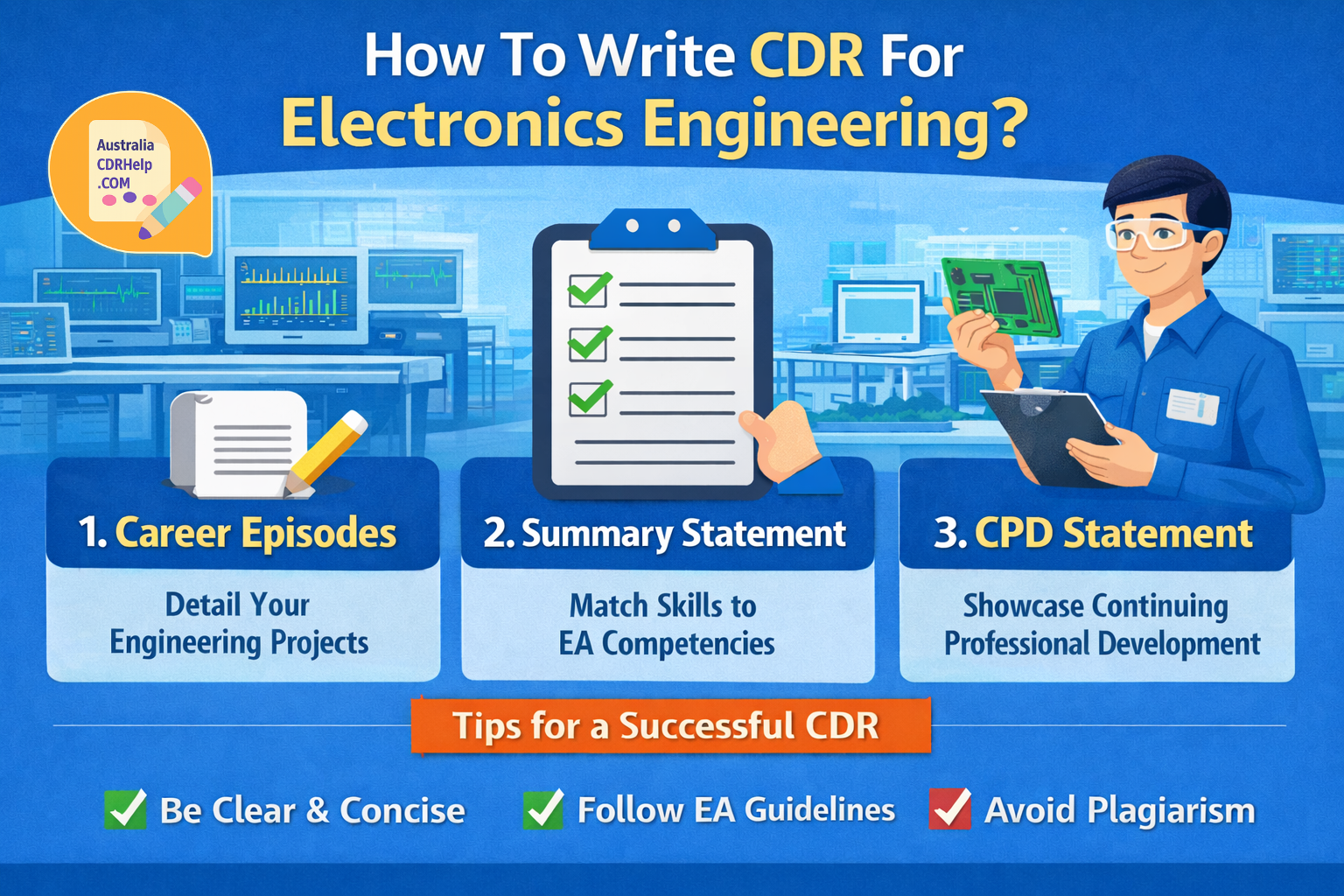
Before you begin writing, you must understand that the CDR consists of three distinct components:
- Continuing Professional Development (CPD) list,
- Three Career Episodes (CEs), and
- CDR Summary Statement.
These documents must work together to provide a holistic view of your career without redundant repetition.
For electronics engineers, the focus should remain on technical design, circuit analysis, and the implementation of complex systems such as telecommunications, robotics, or signal processing.
Here you will find a step-by-step guide to preparing a competency demonstration report (CDR) for ANZSCO 233411, Electronics Engineering, effectively.
Step 1: Compiling Your Continuing Professional Development (CPD)
The CPD is a one-page list that demonstrates how you have kept your engineering skills current after your graduation. It shows EA that you are an active learner who stays up to date with evolving technologies such as 5G, IoT, and advanced semiconductor design.
- Include formal postgraduate studies or short technical courses.
- List seminars, workshops, and technical inspections you have attended.
- Include self-study of technical manuals, books, or journals relevant to electronics.
- Present the information in a clear table format, including the title, date, duration, and venue.
Step 2: Selecting and Drafting Three Career Episodes
Your Career Episodes are the most critical part of the CDR. Each episode should be a detailed narrative (1,500 to 2,500 words) focusing on a specific project or a significant period of your engineering activity. You need to write these in the first person, using “I” rather than “we,” to emphasise your individual contribution rather than the team’s achievements.
I.Drafting the Introduction and Background
Each episode begins with an introduction that sets the stage with dates, project location, and your specific job title. Following this, provide a background of the project. Explain the overall objectives, the nature of the technical environment, and a brief organisational chart showing your position.
II. Detailing Personal Engineering Activity
This is the core of the episode where you describe the actual electronics engineering work you performed. Focus on applying your technical knowledge. For example, if you were designing a PCB, do not just say you “designed a board.” Detail the software you used, the specific components you selected, and the calculations you performed for impedance matching or thermal management.
III. Summarising Outcomes
End each episode with a summary of the project results. Highlight whether the project met its goals, any awards you received, and how your personal contribution ensured the project’s success.
Step 3: Mapping Competencies in the Summary Statement
Once your Career Episodes are complete, you must cross-reference them in the Summary Statement. This is a one-page tabular document that maps specific paragraphs from your episodes to the EA competency elements.
Related Link ⇒ CDR for Engineers Australia
As an Electronics Engineer, You are Assessed on Three Main Areas
| Competency Area | What to Demonstrate |
| Knowledge and Skill-Based | Understanding of circuit theory, digital systems, and engineering mathematics. |
| Engineering Application | Ability to use tools like MATLAB or LabVIEW to solve design problems and test hardware. |
| Professional Attributes | Ethical conduct, effective communication, and team leadership in a technical environment. |
Technical Documentation and Language Standards
Engineers Australia is highly particular about the quality of the English used in your report. You must use Australian English and maintain a professional, technical tone throughout. Avoid flowery language and stick to the “Active Voice” to describe your actions; phrases like “I calculated,” “I designed,” and “I tested” are preferred.
Avoiding Plagiarism and Over-Technicality
Plagiarism is grounds for immediate rejection and may result in a ban on applying. Even if you use a sample for structural guidance, the content must be your own. Additionally, while the report is technical, avoid excessive jargon that doesn’t serve the purpose of proving your competency. The assessor needs to understand the engineering logic behind your decisions, not just a list of specifications.
Project Selection for Electronics Engineers
To provide a diverse profile, select projects that show different facets of the field.
- Project 1: Might focus on hardware design, such as an embedded system or a power supply unit.
- Project 2: Could highlight software or firmware development, like programming a microcontroller or developing a signal processing algorithm.
- Project 3: Might focus on system integration or commissioning, such as installing a communication network or an industrial automation line.
Final Review and Submission Checklist
Before you upload your documents to the EA portal, conduct a final audit of your CDR report. Ensure that every paragraph in your Career Episodes is numbered (e.g., 1.1, 1.2, 1.3) so they can be easily referenced in your Summary Statement. Verify that your CV is up to date and matches the dates in your episodes.
Consistency is key; if your CV says you were a Junior Engineer during a project, but your episode claims you were the Lead Designer, it will raise red flags.
Read Related Blog ⇒ How Much Money Does an Electronics Engineer Make in Australia?