
Writing a proper Competency Demonstration Report (CDR) for ANZSCO 233311 Electrical Engineers is the technical gateway seeking to validate their skills for Australian migration. Engineers Australia (EA) uses this document to determine if your overseas qualifications and work experience align with the Australian Washington Accord standards.
For an Electrical Engineer ANZSCO 233311, the focus must be on your ability to design, develop, and supervise the manufacture, installation, and operation of electrical systems and power generation equipment.
Core Elements of an ANZSCO 233311 Electrical Engineering CDR
To provide a comprehensive overview of your professional standing, you must compile three specific types of documentation. These documents collectively prove that you possess both the theoretical knowledge and the practical application skills required to work in the Australian energy and infrastructure sectors.
I) Three Detailed Career Episodes
Each Career Episode is an essay-style account of a specific engineering project. You must describe your application of electrical engineering knowledge. It is vital to use the first person (“I”) to ensure the assessor credits you, not your team, for the technical decisions made.
II) The Summary Statement
This is the most critical analytical document in your CDR. It consists of a table that cross-references the competency elements required by EA with specific paragraphs in your Career Episodes. It serves as an index for the assessor to verify your expertise in areas such as ethical conduct, mathematical modelling, and project management. There are 4 different summary statements for different occupation categories.
III) The Continuing Professional Development (CPD)
The CPD serves as evidence that you have kept pace with the rapid technological shifts in electrical engineering. This is a one-page list including:
- Post-graduate studies or specific technical certifications (e.g., Solar PV design or PLC programming).
- Attendance at industry conferences or power systems webinars.
- Mentoring junior engineers or delivering technical presentations.
- Participation in professional bodies or volunteer engineering work.
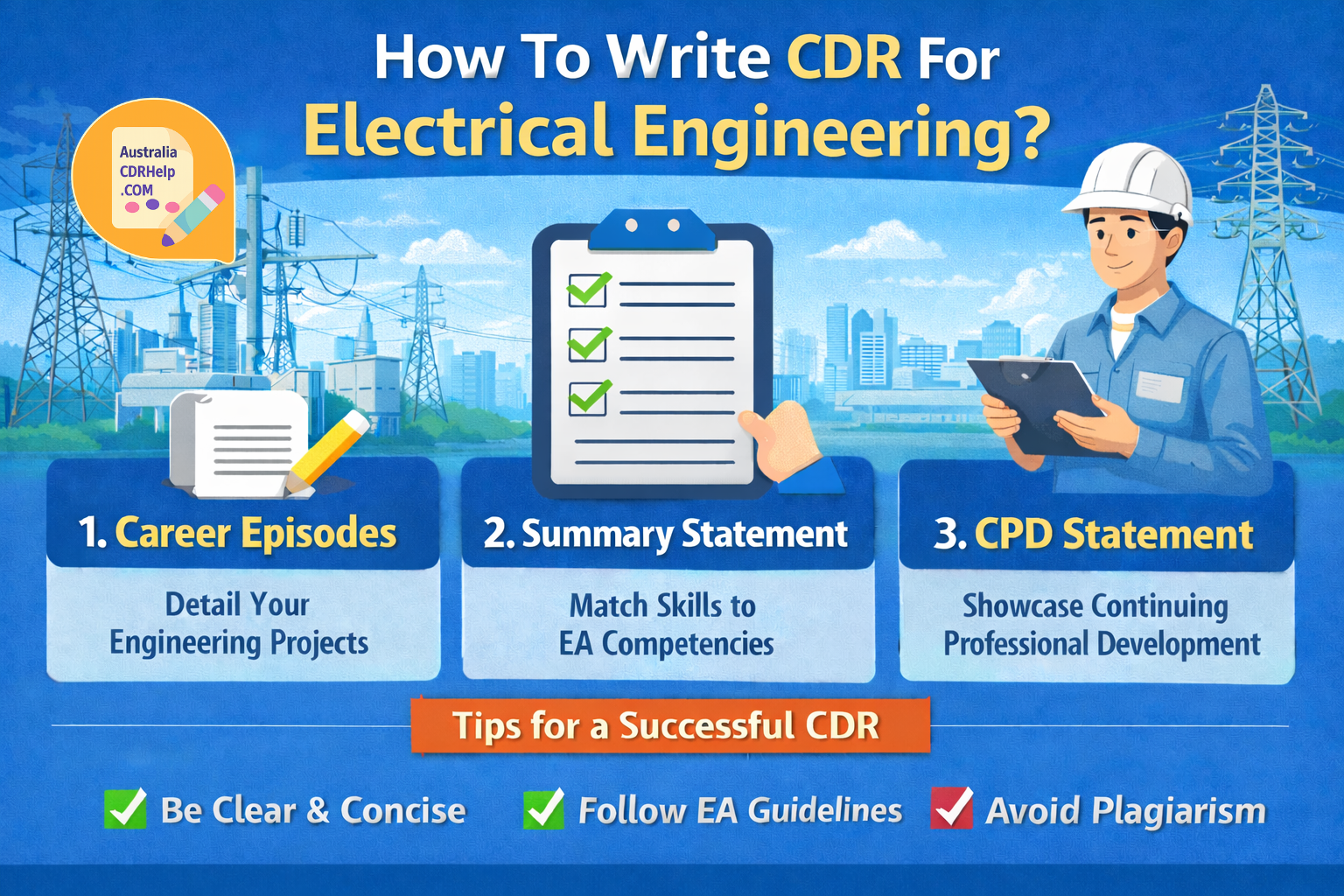
Various Steps to Write an Electrical Engineering ANZSCO 233311 CDR
Success in the CDR process depends on how well you translate your technical history into the specific format required by the Migration Skills Assessment (MSA) booklet. Following a structured sequence ensures that your technical narratives remain focused and logical.
Step 1: Strategic Project Selection
Identify three projects that showcase a broad range of electrical engineering competencies. For ANZSCO 233311, you should ideally select projects with varying levels of complexity. For instance, one could focus on a high-voltage substation design, another on a commercial building’s electrical services, and a third on a renewable energy integration project.
Step 2: Technical Drafting and Calculations
Before you begin writing the narrative, gather the technical data. You will need to mention specific software used (e.g., ETAP, DIALux, or AutoCAD Electrical) and the calculations you performed. Whether it was determining cable sizing based on voltage drop or calculating the fault current for a switchboard, these details provide the necessary “proof of competence.”
Step 3: Drafting the Narrative Sections
Write your Career Episodes following the mandatory EA structure:
- Introduction: Define the project timeline, location, and your specific job title.
- Background: Explain the project’s overarching goal and the organisational structure you worked within.
- Personal Engineering Activity: This is the technical core. Describe the specific problems you faced and the engineering principles you applied to solve them. For example, explain how you addressed electromagnetic interference or how you optimised a power grid’s stability.
- Summary: Briefly state the outcome of the project and how your contribution led to its success.
Step 4: Final Mapping to the Summary Statement
After your episodes are written, you must meticulously map them to the Summary Statement template. This requires you to read through your essays and extract the exact paragraph numbers that prove you can, for instance, “understand the social and environmental consequences of engineering activity.” You can use a particular summary statement template for specific occupation categories, like
- Professional Engineer
- Engineering Technologist
- Engineering Manager
- Engineering Associates
Related Link ⇒ CDR for Engineers Australia
Technical Skills Specific to ANZSCO 233311 Electrical Engineer in Australia
The assessment for Electrical Engineers is rigorous regarding technical specifics. You cannot be generic; you must demonstrate an understanding of the Australian electrical landscape, including safety regulations and voltage standards.
| Technical Competency | Relevant Evidence in CDR |
| System Design | Load calculations, SLD (Single Line Diagram) development, and lighting design. |
| Power Systems | Analysis of transformers, switchgear, and protective relay settings. |
| Safety and Compliance | Adherence to AS/NZS 3000 (The Wiring Rules) or relevant IEC standards. |
| Testing & Commissioning | Descriptions of insulation resistance tests, continuity tests, or earth leakage testing. |
Emphasising Design and Analysis
Design is a heavyweight area for Electrical Engineers. You need to explain the “why” behind your choices. If you chose a specific circuit breaker, explain the breaking capacity requirements you calculated. If you designed a motor control centre, describe how you managed the starting currents and thermal protection.
Safety, Ethics, and Risk Management
Australia has some of the world’s strictest electrical safety standards. Your CDR should explicitly mention your involvement in safety audits, the creation of Safe Work Method Statements (SWMS), and your adherence to environmental regulations regarding electronic waste or energy efficiency.
Final Review and Documentation Integrity
The final stage of preparing your CDR report involves ensuring that the tone is consistently professional and that the data is verifiable. Small formatting errors or inconsistencies in your timeline can delay your assessment.
What Causes Electrical Engineering CDRs to Face Rejection for Plagiarism, and How Can You Avoid This Pitfall?
Engineers Australia is uncompromising regarding plagiarism. Do not use templates or copy and paste project descriptions from the internet. The assessor is looking for your personal engineering journey. Even if you use a “sample” for structural guidance, every technical sentence must be your own work.
Verifying Employment and Qualifications
Ensure that the dates and roles described in your Career Episodes perfectly match your reference letters and your CV. Discrepancies between your narrative and your official paperwork are a major red flag during the assessment process.
Quality Control and Formatting
Check your work for technical accuracy and clarity. Use clear subheadings and avoid long, rambling paragraphs. A professional, clean layout allows the assessor to find the information they need quickly, which often results in a smoother approval process.
Figuring out these requirements can be tricky, but you don’t have to handle it by yourself. Australia CDR Help offers expert help that fits the unique details of Australian migration skills assessments, making sure your report is accurate and well-formatted.
Related Blog ⇒ How to Make CDR for Engineers Australia?