
A Competency Demonstration Report (CDR) for ANZSCO 233512 Mechanical Engineer is a technical dossier required by Engineers Australia (EA) to assess your qualifications and work experience against Australian standards. A CDR for an EA report must provide evidence that you can apply mechanical engineering principles to design, develop, and maintain machinery, manufacturing systems, and thermal power equipment.
Step-by-Step Process to Write CDR for ANZSCO 233512 Mechanical Engineering
Writing a CDR requires a systematic approach to ensure you don’t miss any technical requirements set out in the Migration Skills Assessment (MSA) booklet. Following these steps will help you organise your documentation effectively.
Step 1: Select Your Academic or Work-Related Projects
Choose three distinct projects from your academic or professional background. For Mechanical Engineering, these should ideally cover different facets of the role.
Step 2: Outline the Technical Content
Before writing, draft the technical problems you encountered in each project. You need to show how you applied mechanical engineering theory, such as fluid mechanics, heat transfer, or materials science, to solve these issues.
Step 3: Prepare Continuing Professional Development (CPD)
The CPD is a concise list of activities you have undertaken to stay updated with advancements in the mechanical engineering field after your graduation. This includes:
- Formal post-graduate study or short courses.
- Workshops and seminars you attended.
- Conferences where you delivered papers or participated as a delegate.
- Private study, including the reading of technical journals or Australian Standards (e.g., AS 1170).
Step 4: Write the Three Career Episodes
Career Episodes are detailed narratives of specific engineering projects or tasks you performed. For the 233512 code, EA expects to see your direct involvement in mechanical design, troubleshooting, or system optimisation. You must write these in the first person (“I designed,” “I calculated”) to highlight your individual contribution rather than the team’s achievement.
Each episode should follow a specific structure:
- Introduction: Dates, location, and the name of the organisation.
- Background: The context of the project and your specific role.
- Personal Engineering Activity: The core of the report. Detail the specific tasks you performed, the software you used, and the Australian standards you followed.
- Summary: A brief overview of the project outcome and your personal contribution.
Step 5: Write the Summary Statement for ANZSCO Occupation Category
Once the episodes are finished, identify which paragraphs demonstrate specific competencies. If paragraph 2.3 of your second Career Episode shows you managing a budget, you will link that to the “Management” element in the Summary Statement table.
This cross-referenced table links your Career Episodes to the specific competency elements required by Engineers Australia. It is the first document the assessor looks at to verify that you have covered all necessary skills, such as mathematical analysis, ethical conduct, and project management.
Related Link ⇒ CDR for Engineers Australia
Important Tips and Advice to Write an Impressive CDR for a Mechanical Engineer
- Engineers Australia assesses your ability to function as a professional in the Australian industry. Your CDR must highlight specific mechanical engineering competencies that align with the 233512 occupational profile.
| Competency Area | Essential Evidence for Mechanical Engineers |
| Design and Analysis | Detailed calculations for stress, strain, and fatigue using FEA or manual methods. |
| Material Selection | Justification for choosing specific alloys or polymers based on thermal or mechanical properties. |
| Standards Compliance | Application of Australian and International standards (ISO, AS, ASME). |
| Resource Management | Oversight of technicians, budget control, and procurement of mechanical components. |
- For the 233512 code, the design element is critical. You need to explain how you developed specifications, created blueprints, and tested prototypes
- Avoid simply saying you “used a machine”; instead, explain how you calculated the torque requirements or determined the safety factors for a pressure vessel.
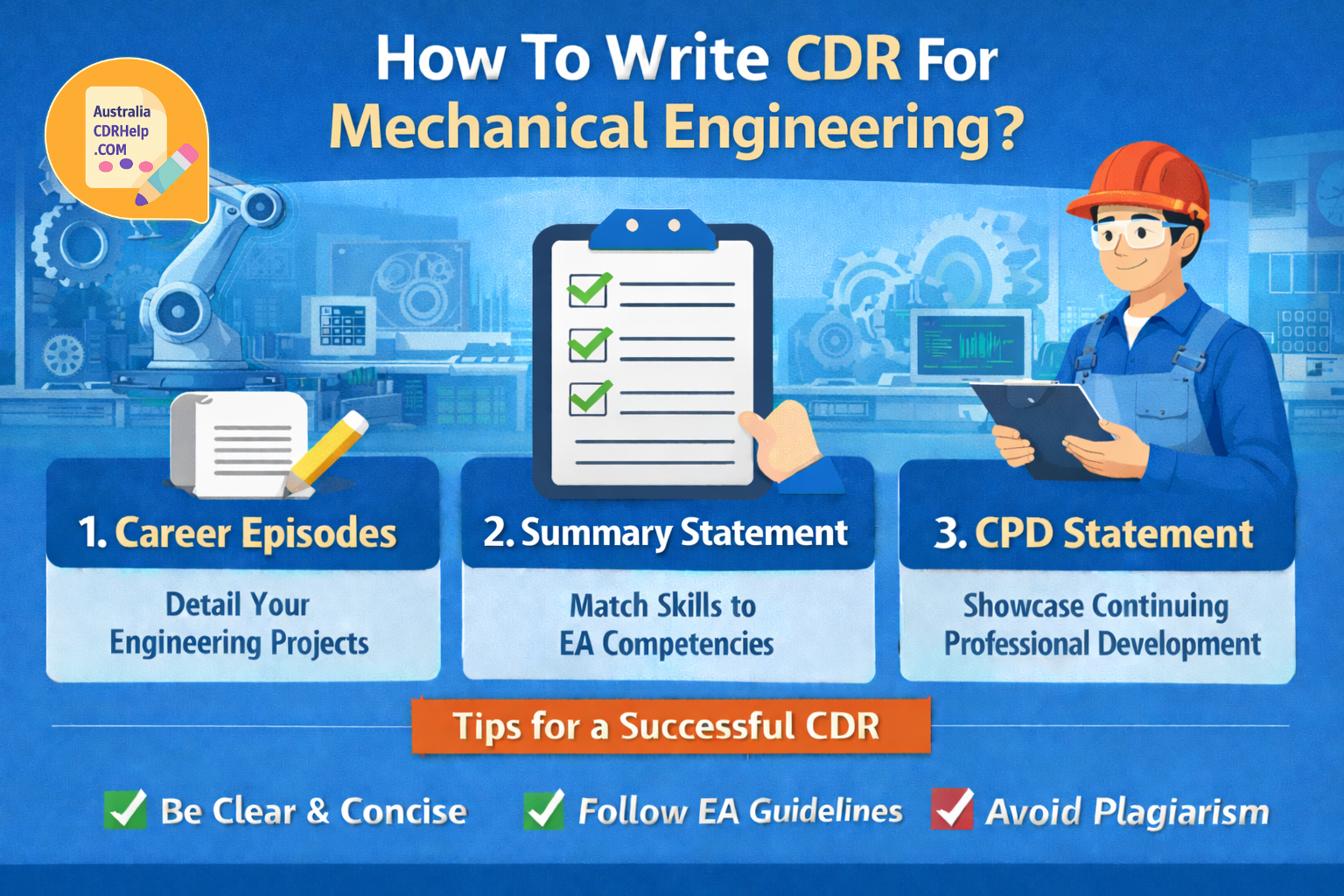
- To successfully migrate as a Mechanical Engineer, you must demonstrate your competency through three distinct elements: a Continuing Professional Development (CPD) list, three Career Episodes, and a Summary Statement. Each section serves a specific purpose in proving your technical and ethical proficiency.
Addressing Safety and Environment
Safety standards strictly regulate mechanical engineering in Australia. Your CDR report should mention how you conducted Risk Assessments or Hazard and Operability (HAZOP) studies. Mentioning environmental considerations, such as energy efficiency in a thermal system or waste reduction in manufacturing, adds significant value to your application.
Common Mechanical Engineering CDR Requirements
Your CDR is a formal application, and the presentation of your data is just as important as its content. You must adhere to specific formatting and evidentiary rules to avoid a rejection or a request for more information.
Language and Tone
Write in Australian English. Ensure your tone is professional. Use clear, active verbs and avoid passive voice where possible to make your personal actions clear.
Plagiarism and Integrity
Engineers Australia uses highly sophisticated software to detect plagiarism. Never copy content from samples available online. Even if you worked on a team project, the description of your actions must be unique to your own experience and written in your own words.
Verification Documents
Every claim you make in your Career Episodes should be supported by your CV and official employment letters. If you mention a project from your third year of university, ensure your academic transcripts reflect that specific coursework. Aligning your narrative with your official documentation is the only way to pass the assessment without delays.
Writing a successful CDR for Mechanical Engineering (ANZSCO 233512) requires a balance between technical depth and structural precision. By focusing on your personal contributions and aligning your engineering tasks with Australian standards, you provide the assessor with clear evidence of your professional competence.
Once you have finalised your three Career Episodes and mapped them accurately to the Summary Statement, your report will serve as a robust foundation for your migration skills assessment.
Related Blog ⇒ How to Make CDR for Engineers Australia?