
The move to Australia as a Production or Plant Engineer is a massive step for your career. We know the pressure that comes with the competency demonstration report (CDR) for Production or Plant Engineer (Anzsco: 233513), as it is the primary document Engineers Australia (EA) uses to judge your technical worth. It is a lot of weight on your shoulders.
You spend your time looking at assembly lines and factory floor layouts. So, translating those physical actions into a formal report feels like an extra layer of labour you did not sign up for. To get your skills assessment right, you need to show you can handle the unique demands of the Australian engineering sector.
What Is CDR For Production Or Plant Engineer?
A CDR for Production or Plant Engineer is required if you want Engineers Australia to assess you as a Production or Plant Engineer (ANZSCO Code: 233513) and your engineering degree is not from an accredited Australian or international program such as the Washington Accord. The CDR is a technical portfolio that demonstrates your qualifications.
Key Steps To Prepare CDR For Production Or Plant Engineer
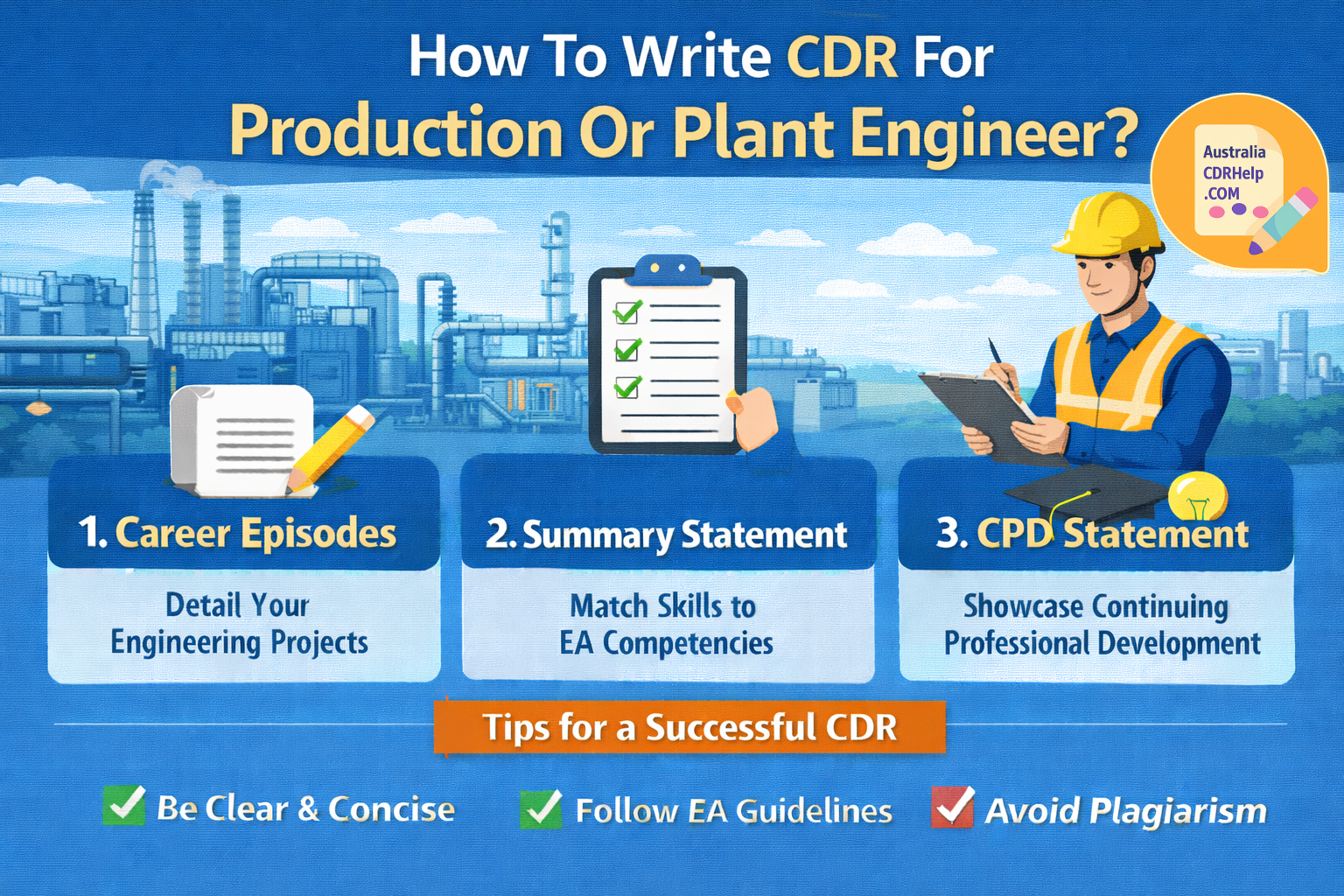
Below are the steps to prepare a competency demonstration report (CDR) for a Production or Plant Engineer seeking skills assessment from Engineers Australia.
1.) Writing The Continuing Professional Development (CPD) List
The Continuing Professional Development (CPD) part of your report is more than a simple list of certificates. It shows you are staying current with modern manufacturing trends and plant safety standards. Engineers Australia wants to see that you have not stopped learning since you graduated from university.
- Include any workshops on Six Sigma or Lean Manufacturing.
- List technical seminars related to plant maintenance or factory automation.
- Mention your private study of Australian engineering standards (AS/NZS).
- Add any short courses on environmental safety or waste management.
2.) Focusing On The Three Career Episodes (CEs)
Your Career Episodes are the core of the submission. Since you are applying as a Production or Plant Engineer, your stories must revolve around efficiency, reliability, and safety.
- You need to pick three distinct projects where you played a lead role. Avoid saying “we did this” or “the team achieved that.” Use “I” to describe how you solved a specific technical problem on the factory floor.
- For a Production Engineer, focus on how you optimised a process to save money or time. For a Plant Engineer, talk about how you kept the machinery running through a clever maintenance schedule.
- You should describe the technical difficulties you faced and the specific engineering methods you used to fix them. If you used CAD software to redesign a layout or implemented a new PLC system, say so clearly.
Technical Differences In Engineering Roles
It helps to know which ANZSCO code you are targeting. While the roles overlap, the focus of your writing should shift depending on your specific job title.
| Feature | Production Engineer Focus | Plant Engineer Focus |
| Main Objective | Maximising output and quality | Maintaining equipment and facilities |
| Typical Project | Reducing assembly line bottlenecks | Installing new steam boilers or HVAC |
| Key Skill | Resource and labour allocation | Preventative maintenance scheduling |
| Software Used | Simulation and ERP tools | Asset management and CMMS |
3.) Crafting A Clear Summary Statement (SS)
The Summary Statement is the final piece of the puzzle. It acts as a cross-reference for your Career Episodes. You have to map every claim of competency to a specific paragraph in your episodes.
This is where most people trip up. If you say you can manage risk, you must point to the exact sentence where you described a risk assessment on the plant floor. It is a tedious task, but it proves you have all the required skills for an Australian engineering role.
Related Link ⇒ CDR for Engineers Australia
Common Errors To Avoid CDR Rejection For Production Or Plant Engineer
We see many engineers fail because they focus too much on company history. Engineers Australia does not care about the size of the company; they care about your technical decisions. Plagiarism is another major issue.
Even if you find a sample online that looks perfect, do not copy it. They use advanced software to check every word. Write your own story in your own voice. Use technical drawings and data to back up your claims, as this adds a layer of authenticity that text alone cannot provide.
Keep your language direct. As a professional engineer, your writing should reflect that. Avoid using vague words and instead use numbers to show your impact. Instead of saying you improved production, state that you increased yield by 15%. This type of specificity makes your report stand out.
How AustraliaCDRHelp.Com Assists In Writing A CDR For Production Or Plant Engineer?
The process of drafting a CDR report is long and requires close attention to small details. You might be an expert in the factory, but writing a migration document is a different skill set. Having a fresh set of eyes helps to spot those gaps in your narrative that you might have missed after staring at the screen for hours.
It is about ensuring your hard work on the floor is clearly visible to assessors who have never seen your plant in person. Professional support bridges that gap between your engineering talent and the paperwork needed for your visa. You want to present a version of your career that leaves no room for doubt about your skills. Every paragraph needs to hit a specific requirement, and getting that balance right takes experience.
AustraliaCDRHelp.Com provides professional CDR writing for Production or Plant Engineers (ANZSCO: 233513), ensuring your report meets EA standards through technical precision, plagiarism-free content, and expert support to help you achieve successful Australian migration.
Related Blog ⇒ How to Make CDR for Engineers Australia?